
Buyer guide
7 Things to Check Before Ordering from a China Supplier
On this page
- Verification Documents
- Written Commercial Terms
- EU destination compliance fit
- Operational Risk Before Production
- Verification Documents
- Written Commercial Terms
- EU destination compliance fit
- Operational Risk Before Production
- Verification Documents
- Written Commercial Terms
- EU destination compliance fit
- Operational Risk Before Production
- Verification Documents
- Written Commercial Terms
- EU destination compliance fit
- Operational Risk Before Production
- Verification Documents
- Written Commercial Terms
- EU destination compliance fit
- Operational Risk Before Production
- Verification Documents
- Written Commercial Terms
- EU destination compliance fit
- Operational Risk Before Production
- Verification Documents
- Written Commercial Terms
- EU destination compliance fit
- Operational Risk Before Production
- What our own supplier screening has taught us
- Which of the 7 checks matters most first?
- What should I confirm in writing before paying a deposit?
- When should I use a third-party inspection?
If I had to cut this article to one line, it would be this: I should not place a China order until all 7 checks are confirmed in writing.
One weak point can turn a seasonal order into dead stock, customs delays, relabelling costs, or lost margin in the currency you sell in. These checks are for a Balkan or Eastern European buyer with a short selling window for garden, camping, and outdoor products. Name the destination in the brief. Serbia, Hungary and the Czech Republic are markets with reviewed buyer evidence on this site. Romania can be the destination as well, as one Eastern European example. Confirm duty, VAT, label language and the entry port for the country you actually ship to.
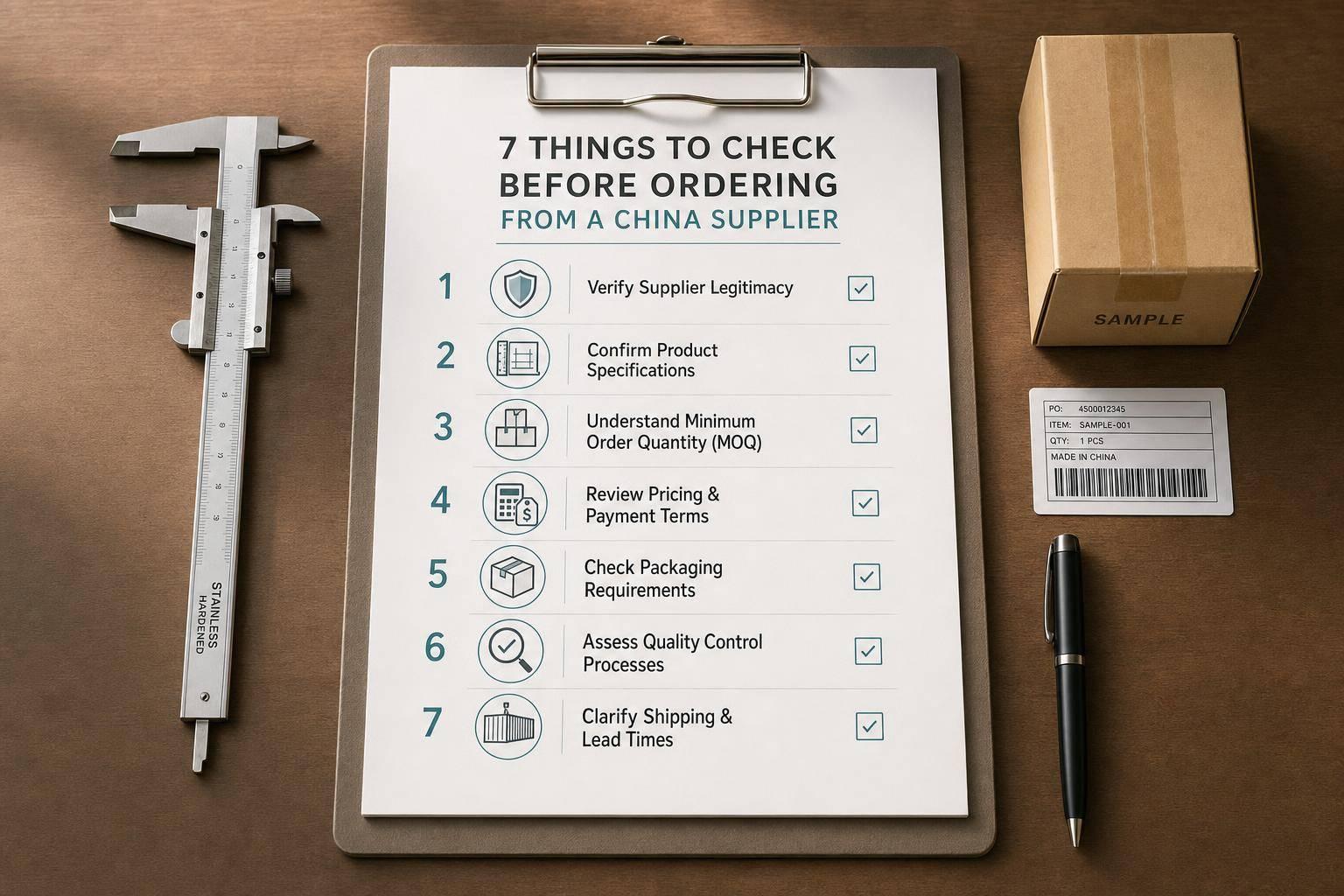
Here’s the full checklist in plain terms:
- Supplier legitimacy: I verify the legal company name, business licence, USCC, export rights, and bank details.
- Product specs and compliance: I lock the spec sheet, materials, tolerances, test reports, and EU paperwork before approval.
- MOQ and samples: I confirm MOQ per SKU/colour, sample terms, and whether mixed orders are allowed.
- Pricing and payment: I check the full landed cost, Incoterm, payment split, and all extra charges.
- Packaging and labels: I confirm carton sizes, barcode placement, warnings and manuals in the destination language, and importer details.
- Quality control: I set PSI rules, AQL limits, defect standards, and link final payment to a PASS report.
- Shipping documents: I review invoice, packing list, HS codes, container details, seal number, and loading proof.
A few numbers show why this matters:
- Import VAT and duty for your destination can shift landed cost quickly if the invoice value is wrong. Ask your broker for the rate and for the value it applies to. In the EU that base often includes the customs value plus freight, insurance and duty, but the rate and the exact base have to be confirmed for the destination.
- A PSI often costs around USD 199–320, while post-arrival fixes can run USD 3.000–10.000 on a USD 20.000 order.
- MOQs in many consumer categories have dropped by 15–25% since 2023, so I may have room to negotiate.
7 Checks Before Ordering from a China Supplier: Risk & Cost Guide
| Check | What I’m checking | If I skip it |
|---|---|---|
| 1. Supplier | Legal status, export history, bank-name match | Deposit loss, customs issues |
| 2. Specs | Materials, dimensions, EU file, destination-language labels | Wrong product, compliance gaps |
| 3. MOQ | MOQ by SKU/colour, sample terms, mixed container option | Overstock, weak sell-through |
| 4. Price | Incoterm, full cost, payment terms | Margin loss, hidden fees |
| 5. Packaging | Carton spec, barcode, warnings, manuals | Rework, warehouse delays |
| 6. QC | Inspection rules, defect limits, retest terms | Defective stock lands at your warehouse |
| 7. Shipping | Invoice, packing list, HS code, loading record | Delays, demurrage, wrong intake |
Bottom line: before I send a deposit, I want the supplier, product, paperwork, packaging, inspection, and shipping file locked down on paper - not in chat.
Before anything else, make sure the supplier is a legally registered company in China, not a trader dressed up as a factory. Start with legal identity. If you can't verify the company, the rest doesn't matter.
Verification Documents
Ask for these documents in order:
- Business licence (营业执照): check the company name, registered address, legal representative, business scope, and current status.
- Exact name match: the company name must be the same across the quotation, proforma invoice, website, and bank account.
- USCC/GSXT status: cross-check the 18-character Unified Social Credit Code on China's National Enterprise Credit Information Publicity System (GSXT). The status should be Active or Operating. If it shows Abnormal, Revoked, or Cancelled, treat that as a deal-breaker.
- Export authority: ask for the supplier's export licence or, if they use an export agent, the agent's name and licence details.
Scan the QR code on the licence and make sure it opens the same GSXT record. If it sends you somewhere else, reject the document.
You should also ask for ISO 9001, BSCI, or SMETA evidence. Then look up litigation, penalties, and ownership changes in Qichacha or Tianyancha.
Written Commercial Terms
Every document, including the quotation, proforma invoice, and purchase contract, must show the supplier's registered address, USCC, and the exact legal name used by the bank beneficiary. That links the contract to a verifiable legal entity, which is what you want if anything goes wrong later.
As Melissa Weng of Ningbo Yufei put it:
"A supplier's response time, accuracy, and consistency often reveal more about reliability than price alone."
EU destination compliance fit
Once the licence checks out, confirm that the supplier can actually export to the EU. Ask for three proof points:
- Recent EU shipment documents: invoices, packing lists, and bills of lading
- References from EU clients
- A business scope on the licence that fits your product category, such as production and sale of outdoor furniture instead of vague trading language
For a buyer shipping into the EU, this part matters more than it may seem. A factory can look fine on paper and still struggle with EU-facing paperwork or product-category fit. Prior EU shipments are context for that factory. Clearance into your own destination still has to be confirmed for the order.
Operational Risk Before Production
After you confirm export experience, move to production risk. A valid registration doesn't mean the factory can deliver your order on time.
Ask about monthly output for your product category, whether any part of the work is subcontracted, and how internal quality checks are recorded. If the supplier answers in broad, fuzzy terms, that's a warning sign. Missed details here can turn into missed delivery dates later.
As Melissa Weng of Ningbo Yufei noted:
"Price alone should never be the deciding factor... The cheapest supplier may carry hidden risks."
After you’ve checked that a supplier is legit, the next headache is simple: the goods arrive, and they’re not what you agreed to.
That happens all the time when specs are vague. If the product details aren’t locked down, quality disputes become almost inevitable. So before you move to samples, pricing, or contract sign-off, pin the spec in place.
Verification Documents
Ask for a signed specification sheet and treat it as the main control document.
It should spell out the product in clear detail, including:
- product name and model
- dimensions in metric units such as cm, m, and kg
- materials and grades
- colour codes like RAL or Pantone
- load capacity
- finish
- assembly method
- hardware details
- tolerance ranges, such as ±5 mm on length or ±3% on weight
For textiles and cushions, add the details people often skip but later argue about: fabric composition, GSM, foam density, and the flammability rating required under EU rules.
For outdoor seating and tables, ask for EN 581 reports. For wood or bamboo, ask for origin and harvesting proof. For coated, plastic, or textile parts, ask for REACH declarations. If CE marking applies, request the Declaration of Conformity and test reports for EMC, LVD, and RoHS.
Don’t ask for a quotation or approve a sample until the compliance pack is complete.
Written Commercial Terms
Attach the specification sheet to your purchase contract as a signed annex. The exact version number and date should also appear on the PO.
Your contract should state, in plain terms, that the product must match both the attached specification sheet and the approved sample. It should also say that the supplier cannot change materials, tube thickness, fabric GSM, foam density, or any other critical component unless you approve it in writing.
To cut down on “we understood it differently” problems, keep the specification sheet bilingual - English plus Chinese. It also helps to back it up with annotated drawings or photos that point to key features.
And one rule matters more than people think: all changes must be confirmed in writing. A call is fine for discussion, but it’s not enough for control.
EU destination compliance fit
Your compliance brief should list GPSR (EU 2023/988) and REACH restrictions where those EU rules apply to the product, plus the labelling language your destination requires.
GPSR has applied since 13 December 2024 and calls for a responsible economic operator in the EU when products are sold to EU consumers. Confirm how that role is filled for your destination before you treat the file as complete.
Safety warnings and care instructions need to be in a language consumers at the destination can use, on both the product and the packaging. Confirm that language before print. Romanian is one example when Romania is the destination; another destination needs its own language. A missing or wrong language file becomes a relabelling cost and can draw a question from that member state's market-surveillance authority.
Operational Risk Before Production
Approve the sample only when it matches the signed spec.
After that, move to the next checks: MOQ, sampling terms, and order flexibility.
Once your specs are set, the next issue is pretty simple: can you buy the right volume without tying up too much stock? This is where MOQ, or minimum order quantity, trips up a lot of importers in this region. It happens even more with seasonal lines like garden furniture or camping gear, where demand depends on the weather and can swing fast.
Verification Documents
Start by asking for a formal quotation or proforma invoice that spells out the MOQ per product, per colour, and per configuration. Don’t rely on one headline MOQ number. In many cases, that lower figure applies only to a single variant. If you want mixed colours, custom prints, or branded cartons, the volume may jump. Ask one thing very plainly: does the MOQ apply per SKU, or can it be spread across a mixed order?
You’ll also want the sample terms confirmed in writing. That means:
- whether the sample is free or paid
- who pays the courier cost
- whether the sample fee is refunded after a bulk order
- whether the sample matches the final pre-production version or is only a showroom reference
As Melissa Weng, Sales Director at NINGBO YUFEI, puts it:
"Each factory has its strengths, and as a buyer, it’s important to identify what a supplier does best before placing an order."
That point matters. A specialist factory can finish a high-quality sample in about 2 days, while a non-specialist may need 3 weeks and still deliver something that misses the quality mark.
Written Commercial Terms
Your purchase contract or PO should list the exact MOQ per item and per colour, plus the terms for any trial order, which is often 50–200 units. It should also set out the sample refund process.
Just as important, the document should confirm whether the supplier allows mixed-SKU containers. That can mean combining home, garden, and outdoor goods in one shipment. For many importers, that’s one of the best ways to hit the total order volume without overstocking one slow-moving item.
If the supplier agrees to any exception, put it in writing. A phone call or WeChat message saying “no problem” won’t help much later.
EU destination compliance fit
One easy mistake is treating the sample as proof that the final order will be fine. It may not be. The sample must match the export-grade, EU-intended version of the item, not a version made for the domestic market.
That difference can be a headache. Domestic-market versions often miss the labelling, materials compliance, or safety paperwork an EU destination asks for. Check that the supplier can keep the same compliance level for both a small trial batch and later repeat orders, including packaging in the destination language and the right markings. Confirm those requirements for the destination before production.
Operational Risk Before Production
MOQ is not always a hard wall. In many cases, it’s a negotiating point. Buyers often get a smaller first order by giving ground somewhere else, such as:
- reducing the number of SKUs
- using simpler packaging
- accepting a longer lead time
There’s also more room to push than many buyers think. Manufacturing overcapacity has lowered MOQs by about 15–25% since 2023 in many consumer categories. That gives you room to negotiate, especially in quieter production windows like March–May or July–August.
For a seasonal buyer, the practical check is simple: can you sell that MOQ within the season without heavy discounting? If the answer is no, then the lower unit cost matters less than the stock risk. At that point, getting the terms nailed down in writing matters more than chasing a small cut in the unit price. The MOQ itself is an order-specific confirmation, not a standing quantity.
Once MOQ and sampling terms are set, the next job is to check whether the quote covers the full landed cost. In seasonal sourcing, even a small pricing error can eat into margin before the sales window even starts. This is usually the point where hidden costs show up for the first time.
Verification Documents
Start with a signed proforma invoice (PI) or sales contract that clearly lists the unit price, currency, exact Incoterm with named place, payment terms, production lead time, and bank details. Also ask for a bank letter confirming the beneficiary name matches the legal company name.
If the product needs tooling or moulds, ask for a separate line item or contract clause. That way, ownership and maintenance fees are spelled out from day one. Every included item should appear in the PI. Don’t assume anything is included unless it is written down.
Make sure the supplier can issue a commercial invoice, packing list, and original bill of lading that match the agreed Incoterm and payment schedule. Customs, VAT, and landed-cost checks at your destination rely on matching documents, so even small mismatches can cause trouble.
Once the PI is clear, fix the cost split in the contract.
Written Commercial Terms
The three terms you’ll see most often are EXW, FOB, and CIF, and each one shifts costs in a different way.
- EXW: goods are made available at the factory gate; the buyer handles export pickup, export customs, and loading.
- FOB: the seller delivers to the port and loads the cargo; the buyer pays ocean freight, insurance, and destination charges.
- CIF: the seller pays ocean freight and basic insurance to the named port; the buyer still pays destination import costs and final delivery.
A common payment setup is 30% deposit / 70% balance. It’s smarter to link the balance to a passed pre-shipment inspection, not just the shipment date. That’s the only way to compare quotes on like-for-like terms.
EU destination compliance fit
A low FOB price can look good on paper and still be a bad deal if it leaves out compliance costs and landed charges. Add destination-language labelling and any compliance paperwork you still have to confirm to your landed-cost model.
Operational Risk Before Production
Put the Incoterm, named place, unit price, and payment schedule in the contract itself, not in a chat thread. If steel, aluminium, plastic resin, or exchange rates may move, add a price-adjustment clause tied to a published index and a clear threshold.
Before you approve the PI, run a simple landed-cost model. Start with the FOB or CIF price, then add freight, insurance, duties, VAT, port handling, inland trucking, and any compliance fees. Convert the final total into EUR and the currency you sell in. If that currency is RON, because Romania is the destination, convert into RON as well. That’s the number that matters for margin planning, not the headline unit price. Duty, VAT and the exchange rate stay confirmation items for that order.
Next, lock packaging, carton marks, and retail labels before production starts.
Pricing and payment terms get most of the attention. But packaging is often where deals start to wobble. If goods arrive with the wrong barcodes, no warnings in the destination language, or cartons that are too heavy for manual handling, you can end up paying for rework, delays, and extra warehouse time.
Verification Documents
Packaging affects freight costs, warehouse flow, and shelf-ready delivery just as much as print accuracy does. Ask for a packaging spec sheet that covers:
- carton size
- gross and net weight
- units per carton
- pallet pattern
- stacking limit
- handling marks
- barcode and SKU placement
You should also request die lines and print proofs for both carton and retail packaging. Before mass printing starts, approve a physical pre-production packaging sample. And before sign-off, scan the barcode yourself. That one small check can save a lot of hassle later.
Written Commercial Terms
Add a Packaging & Labelling Annex to the deal. It should include the approved artwork version and date, carton size and weight tolerances, and who pays for re-packing or re-labelling if something goes wrong. Once the Golden Sample is approved, freeze packaging changes unless you give written approval.
Get written confirmation on whether the unit price includes inner bags, foam inserts, colour boxes, master cartons, labels, and pallets. Don’t leave this fuzzy. It’s one of those details that seems minor until the invoice lands or the goods show up half-packed.
Set a carton weight limit that fits manual handling. Also state if multi-piece sets must ship in one carton. If that point is vague, sets can arrive split across boxes, which turns picking and receiving into a mess.
EU destination compliance fit
Packaging needs to show the details buyers need both on the shelf and at customs. Retail labels should include the EU importer name and address, country of origin, and safety warnings in the destination language, in clear, easy-to-read text. Confirm whether a CE mark applies to this product. Use it only when the product is covered and the technical documentation is already valid.
Operational Risk Before Production
Get your warehouse or logistics team to review carton dimensions and weights before you approve the spec sheet, not after the goods arrive at your entry port. Constanţa is one Black Sea port an Eastern European shipment may use. Confirm the port named on your booking.
Check the barcode, compare carton dimensions with warehouse handling limits, and ask for pallet photos before the container is sealed. Carton size, weight, and barcode placement shape receiving speed, rework, and launch timing.
After packaging is locked, the next check is the pre-shipment inspection.
Once the packaging is approved, the next step is simple: check whether the goods actually match what you ordered.
A pre-shipment inspection, or PSI, is your last practical chance to spot problems while the goods are still in China, before they leave the factory. At this stage, the inspector checks whether production followed the approved sample, the final specs, and the agreed packaging.
Verification Documents
Before the inspection company goes to the factory, get your file in order. You should have the approved sample, final spec sheet, packaging artwork, and the latest product test reports ready to send over.
Those reports should include photos and should not be older than 1–2 years. For outdoor furniture, ask for proof of conformity with EN 581. For camping products that use plastics or coatings, review the relevant REACH documents, along with any other category-specific test reports. It also helps to request technical documents such as material specs, load ratings, and drawings with tolerances in millimetres.
Send the inspection company:
- your purchase order
- approved sample photos
- packaging artwork
- a defect classification list for critical, major, and minor defects
The inspection checklist should cover dimensions, load or function tests, workmanship, packaging strength, labelling, and accessories. If a report is missing or out of date, require retesting at a recognised lab before production approval.
Written Commercial Terms
Add a dedicated Quality Control & Inspection clause to your contract. This clause should state when the inspection takes place, who carries it out, which standard applies, and what happens if the goods fail.
For PSI, set the inspection point at 80% of the goods finished and packed. Use AQL 2,5 for major defects and AQL 4,0 for minor defects. Critical defects need to be defined in plain language, with examples like a broken weld or a missing safety label. Any critical defect should fail the lot.
Tie the inspection result directly to payment and shipment. Final balance release and container loading should depend on a PASS report. If the goods fail, the supplier should rework them at its own cost and accept re-inspection at its own cost.
Put the re-inspection deadline in writing too. A failed PSI can push back your launch window, and in a short Balkan or Eastern European season that can hurt more than people expect, especially when delayed stock can sit unsold.
EU destination compliance fit
For importers selling in this region, PSI is not just about looks or finish quality.
Inspectors should also check that safety instructions, assembly manuals, and required warnings are present in the destination language and are correct. That point is easy to miss, but it can create trouble fast if the shipment lands without the right paperwork in the box.
Use the CE mark only where it actually applies and only when it is backed by the correct technical file and Declaration of Conformity. If the supplier cannot provide that file, stop the shipment.
Operational Risk Before Production
PSI is cheap insurance. On a USD 20.000 order, post-arrival fixes can cost USD 3.000–10.000, while inspection is about USD 199–320.
For new suppliers or more complicated items, add an early-production check at 20–30% completion. That gives you a shot at catching issues before the whole batch is finished. For repeat orders from a supplier with a proven track record, one PSI with standard AQL levels may be enough.
After a PASS report, confirm loading, seals, and export documents before the container leaves the factory.
After a PASS PSI, there’s still one more gate: shipment control. A passed pre-shipment inspection does not mean the goods are ready to move. The last check is simple but strict: the container must be loaded, sealed, and documented the right way before cut-off.
Verification Documents
Before you confirm the shipment, ask for a draft commercial invoice and packing list as early as possible. Then check them line by line against your purchase order. SKUs, product descriptions, quantities, unit prices, and HS codes should match exactly.
Stick to metric units across the paperwork:
- weights in kg
- dimensions in cm
- values in EUR or the currency you sell in
Also request carton-mark samples. Once loading is done, the supplier should send the container number, seal number, loading date, and loading photos straight away.
Written Commercial Terms
State the Incoterm and port in the contract, then spell out who books the container, pays local charges, and clears export customs. Those points decide who controls the container, who handles the documents, and where the goods can be released.
It also helps to add a loading clause. Ask for even weight distribution, dunnage or airbags, and cartons that are not damp or damaged. Be direct here. Shipping documents should need your approval before the original bill of lading is released and before final payment is made.
EU destination compliance fit
For outdoor furniture and camping goods entering your EU destination, the commercial invoice should use clear product descriptions. Don’t allow vague labels like "furniture". The invoice should also show the HS codes and material details your broker has confirmed for those goods. If descriptions are too broad, customs may order a re-inspection and hold up delivery. Treat a supplier's suggested code as a question for the broker, not as the code to declare.
Packaging matters too. Use scan-ready packaging, strong carton board, and manuals in the destination language to cut damage, returns, and extra warehouse handling. Check that packaging inserts, box leaflets, and final retail pack contents include durable printed safety instructions and assembly manuals in that language.
Operational Risk Before Production
For a first full-container order, supervise loading, check that the container is clean and dry, and record the container and seal numbers. The inspector should photograph each stage of loading. If a damage claim comes up later, that record can make all the difference.
Send the container number and seal number to your logistics partner before the vessel departs. That gives them time to prepare customs clearance at the entry port named on the booking. Constanța is one Black Sea option some Eastern European shipments use. Confirm the port on the booking.
Use the risk snapshot below to rank the shipping risks that still remain before you book freight.
Use the table below as a fast scan of the seven checks, the red flags, and the fallout at your destination. If you've already gone through the detailed checks above, this snapshot helps you spot the biggest weak points before you sign off on the order.
| # | Check | What to Verify | Warning Signs | Risk if Ignored | Impact on destination operations |
|---|---|---|---|---|---|
| 1 | Supplier Legitimacy | Valid business licence; export rights; name matches bank details | Price changes after initial quote; slow or inconsistent replies; no prior EU-bound shipments | Deposit loss; name mismatch on documents | Customs hold at the entry port; deposit loss; VAT delay |
| 2 | Product Specs & Compliance | Material specs in metric units; relevant EU conformity files; material certificates; wood/bamboo origin proof; test reports | Vague descriptions; supplier cannot name specific EU requirements; no dimensional tolerances | Products fail inspection; compliance gaps; customer complaints | Questions from customs or the destination's market-surveillance authority; delisting from retail platforms; stock write-offs |
| 3 | MOQ, Sampling & Flexibility | MOQ per SKU, per colour, and per configuration; sample terms confirmed in writing; bulk goods match approved sample | Sample takes over 3 weeks; changing sample charges after negotiation; refusal to confirm bulk will match sample | Dead stock; excess warehouse space; poor sell-through on seasonal items | Cash-flow strain in your selling currency; warehouse space wasted on unsellable stock |
| 4 | Pricing, Incoterms & Payment | Unit price, currency, Incoterm, shipping responsibility, payment schedule; all-in quote including cartons, inserts, labels, inland transport | Price changes after sample approval; full prepayment required upfront | Unexpected add-on fees post-deposit; margin collapse | Higher landed cost; weaker margin in your selling currency |
| 5 | Packaging, Carton Marks & Labels | Strong corrugated board matched to product weight; carton dimensions in cm and weight in kg; scan-ready barcodes; SKU references; country-of-origin marking; manuals and safety instructions in the destination language | Single-wall boxes; no barcodes; English-only or missing manuals; artwork not finalised before production | High damage rates; retail listing mismatches; warehouse intake errors | Warehouse intake problems; retail listing mismatches; relabelling costs |
| 6 | Quality Control & PSI | Third-party inspection accepted in writing; AQL levels, defect limits, and test responsibilities agreed before shipment; quantity, dimensions, functionality, packaging, and barcodes checked against approved sample | Supplier refuses third-party access; pressure to pay before PSI is complete; no written defect standard | Full container of defective stock; markdowns and write-offs in short seasonal windows | High reverse-logistics costs in your selling currency; brand damage |
| 7 | Shipping Readiness, Container Loading, and Documents | Container loading plan; carton count confirmed; loading photos provided; commercial invoice and packing list match the PO line by line (weights in kg, dimensions in cm); correct HS codes; and any origin documents required for customs | Missing carton count confirmation; no loading photos; inconsistent weights and volumes; late document issuance | Customs delays; demurrage fees; wrong receiving records | Warehouse intake delays; listing errors; disrupted retail launch timing for the season |
One point matters more than many buyers think: import VAT at the destination is often charged on more than the product price alone. Ask your broker whether the base includes the customs value plus freight, insurance and any duty due. A small unit-price mistake on the commercial invoice can then skew more than duty. It can skew the full landed cost in the currency you sell in. The rate itself is a confirmation for that destination, not a figure this guide can state.
That’s why the document check in row 7 isn’t just admin. It’s a margin control step.
These seven checks are your go/no-go gate before production begins. Use them as a pre-order filter for every order, whether it’s a first shipment or a stock refill before the next season.
The clearest rule is simple: if a supplier can’t confirm all seven points in writing, stop the order until every point is confirmed in writing. If even one point is still open, the order is not ready.
That last check turns the list from a planning tool into an order decision. It helps protect your margin in the currency you sell in before production starts.
What our own supplier screening has taught us
The seven checks are the paperwork. The three situations below are the points that usually get missed, and they show why each one has to be confirmed rather than promised. They are checks for the order, not a record of a particular shipment and not a rule about every factory.
- A corrected manual is not proof until someone checks the print run. Photos and videos of a reprint are not the same as the manuals in the cartons. Ask for the corrected print run to be checked during inspection, not only shown in photos.
- A delivery promise needs a capacity check. Confirm the factory's current order load and whether materials are actually on the floor before a seasonal order, and keep a backup factory in view for time-critical items. A vague update after a holiday is a reason to visit or to ask for that evidence, not a reason to treat the date as fixed.
- Early replies predict the rest of the order. A salesperson who understands the brief quickly and recommends suitable items usually makes the whole order smoother; slow replies or unsuitable suggestions at the start tend to cost time later. We also stop early when a factory's product does not meet the standards the buyer needs or its price is far outside the budget, and we look more closely at factories that specialise in one product family.
Start with small trial orders or samples with a new factory, write the quality and delivery requirements into the contract, and agree how progress will be reported. If you are comparing several factories for a seasonal range, send the shortlist and the decision you still need to make in a short brief, so the open checks can be reviewed item by item.
Which of the 7 checks matters most first?
Supplier legitimacy comes first. It sets the base for everything that follows, from specs and pricing to production details.
Start here, and you’re far more likely to work with a genuine manufacturer that can handle your home, garden, and outdoor furniture needs.
What should I confirm in writing before paying a deposit?
Before you pay a deposit, get every key order detail in writing. It keeps things clear and gives both sides something concrete to refer back to.
That written record should cover product specifications, pricing and payment terms, MOQ and sampling terms, packaging standards, carton markings, and quality control and pre-shipment inspection requirements. This step can cut risk before production starts.
When should I use a third-party inspection?
Use a third-party inspection as a key checkpoint before goods leave the factory. It helps confirm quality and compliance before shipment.
An independent inspector gives you an objective check of product specifications and quality standards. Whether Ningbo Yufei arranges a pre-shipment check, or you appoint your own inspector, confirm who books it, what the report covers, and how a failed result affects payment. That scope is an order-specific confirmation.