
Buyer guide
Landed Cost Q&A for China Seasonal Product Buyers
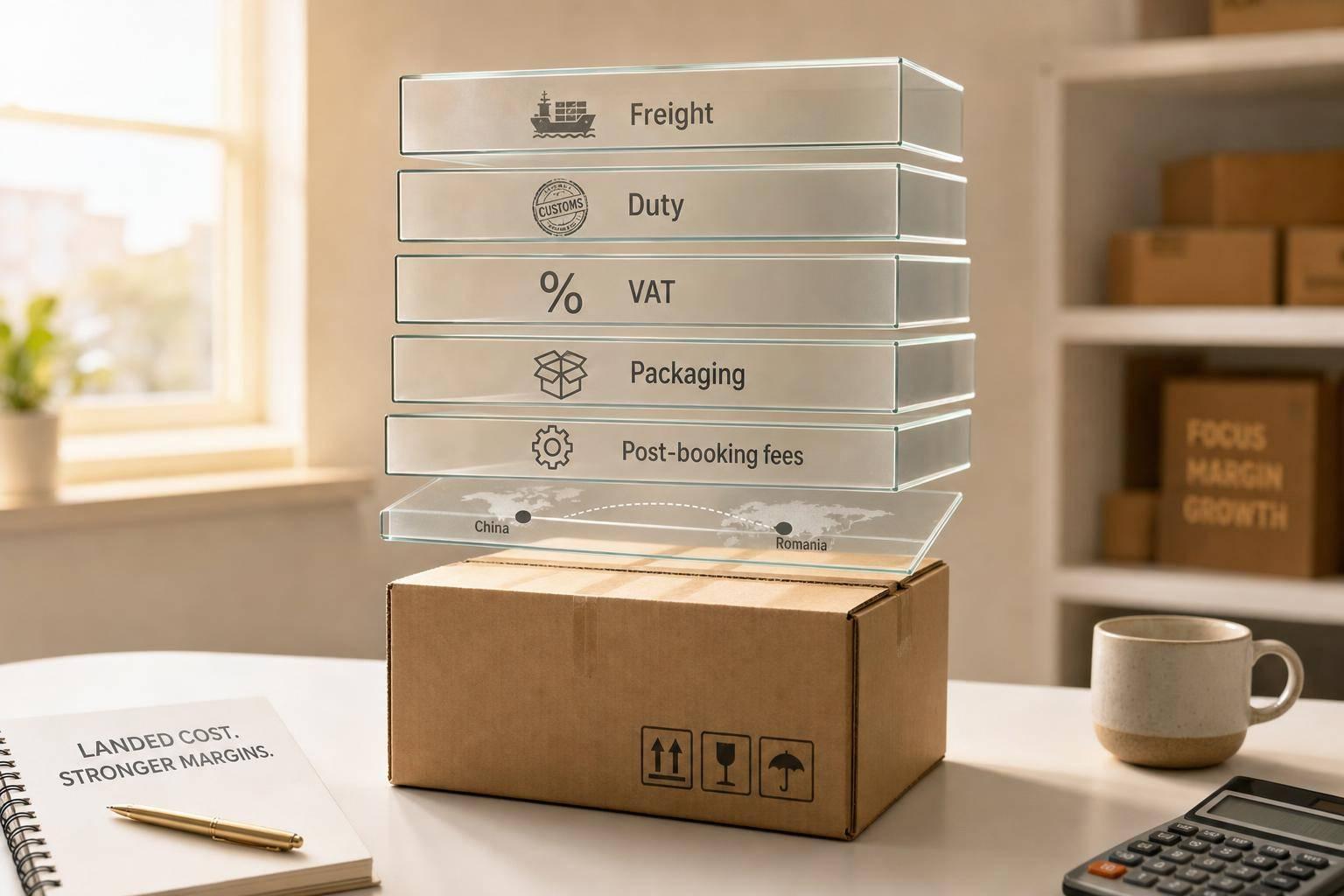
On this page
- Base cost components in a destination import calculation
- When cost estimates are acceptable and when exact figures are needed
- A per-unit cost formula buyers can apply in their selling currency
- Which fixed charges hit small orders the hardest
- How to build two cost views: test order vs repeat order
- Supplier support that can improve low-MOQ cost control
- How carton size and pack format change freight cost
- When a higher packaging cost leads to a lower total landed cost
- Comparison table: three packaging formats and their cost effect
- Common extra charges after booking and during customs handling
- Comparison table: post-booking charges, impact, and how to reduce risk
- Conclusion: cost controls that protect margin on seasonal imports
- When should I stop using estimates?
- How should I price a low-MOQ test order?
- Which post-booking charges should I buffer for?
If I price a seasonal import from China without a landed-cost model, I risk losing margin before the stock even reaches my warehouse. This note is for a Balkan or Eastern European buyer. Serbia, Hungary and the Czech Republic are markets with reviewed buyer evidence on this site. Romania can be the destination, as one Eastern European example.
For me, the core point is simple: landed cost is not just the supplier price. It is the total cost to move goods from China to my warehouse, including freight, duty, VAT, customs fees, terminal charges, insurance, and local delivery. Duty and VAT are confirmed for the destination. On bulky seasonal items, one carton-size error or one customs issue can shift unit cost fast.
Before I approve a PO, I need to check:
- Incoterm
- Unit price
- Carton size in cm
- Gross and net weight in kg
- Units per carton
- HS code
- Freight mode
- Destination VAT, confirmed with my broker
- Final delivery point at my destination
I also need to model two cost views:
- Test order cost for low-volume LCL or air shipments
- Repeat order cost for FCL and better loading
A few points stand out:
- Bulky products like gazebos, swing chairs, and BBQ items can waste container space
- Fixed fees hit small orders harder because they are split across fewer units
- Packaging choice can cut or inflate freight cost per unit
- Post-booking charges like amendments, storage, PSI, customs holds, and FX shifts can still change the final number
- Per-unit landed cost should be based on units loaded, not units ordered
One example in the article makes this clear: a flat-pack carton at 55 × 50 × 10 cm has about half the volume of a larger retail gift box. If freight is charged on volume, the freight line should move with that volume. Ask the forwarder for the rate. This article does not state a lei price.
| Area | What I need to watch | Why it matters |
|---|---|---|
| Product data | Carton size, weight, packing qty | Wrong data skews freight and per-unit cost |
| Order type | Test vs repeat | Small orders carry more fixed cost per unit |
| Packaging | Flat-pack, standard carton, gift box | Pack format changes CBM and damage risk |
| Customs | HS code, CE, wood or bamboo papers | Missing files can lead to holds and storage |
| After booking | Amendments, PSI, FX, delays | Final landed cost can still move |
So my takeaway is clear: I should build the landed-cost model early, confirm the loading plan before booking, and leave room for post-booking costs before I set my selling price in the currency I sell in.
Use the inputs above to move from a rough estimate to a booked landed cost.
Base cost components in a destination import calculation
Landed cost builds step by step. If your carton size or weight is off, every number after that can shift too.
| Cost Component | What It Covers | Calculation Basis |
|---|---|---|
| Product cost | Unit price under EXW or FOB terms | Supplier invoice |
| China-side handling | Handling costs at origin | Origin handling quote |
| International freight | Sea or air freight to your entry port | Carrier quote |
| Cargo insurance | Coverage for the shipment | Insurance quote |
| Customs duty | Confirm the customs value duty is assessed on | Customs valuation |
| Destination VAT | Confirm the rate and the base. In the EU the base often includes the customs value plus duty | Broker's calculation for this destination |
| Customs broker and clearance fees | Agent and document handling | Service invoice |
| Terminal handling (THC) | Port charges at your entry port. Constanța is one Black Sea example | Port invoice |
| Inland delivery | Trucking from your entry port to your warehouse | Trucking invoice |
For bulky seasonal goods, freight and THC can eat up a lot more per unit. That’s where a small packing mistake turns into a bigger cost problem than many buyers expect.
Before booking, treat this as a planning model. After booking, swap those rough numbers for confirmed charges.
When cost estimates are acceptable and when exact figures are needed
Estimates are fine early on, especially when you're comparing suppliers or sketching out a first budget. But once you get close to PO approval, you need exact figures.
Final sell-price setting, PO approval, and container booking all need confirmed freight rates, actual carton dimensions, and a confirmed loading plan. In plain terms: this is the point where “close enough” stops being good enough.
The tighter the order, the more these figures matter.
A per-unit cost formula buyers can apply in their selling currency
Once all charges are confirmed, add them together and divide by the number of units actually loaded.
Per-unit landed cost = total shipment cost in your selling currency ÷ units loaded
Use units loaded, not units ordered. That detail matters. If bulky seasonal goods don’t fill the container the way you planned, the freight cost per unit can jump fast.
Update the number after the loading plan is confirmed, then use it for the selling price in your currency. If Romania is the destination, that currency may be lei (RON).
This hits hardest on small test orders, where fixed charges push unit cost up the fastest.
A test order needs its own landed-cost model. If you price it like a scaled-up shipment, your margin math can go wrong from day one.
Which fixed charges hit small orders the hardest
Documentation, inspection, certification, and packaging setup costs get spread across fewer units in a small seasonal trial - say, a few dozen camping chairs or garden hammocks. That pushes the per-unit landed cost up fast. Poor loading estimates make things worse. If the actual volume comes in below plan, extra freight and handling push per-unit landed cost up straight away.
Use separate test and repeat models before you decide if the SKU can scale.
How to build two cost views: test order vs repeat order
Build two landed-cost models: test order and repeat order.
For the test shipment, use actual LCL or air freight rates, real carton dimensions, and confirmed fixed charges spread across the units you’re shipping. For the repeat order, use FCL assumptions, higher unit counts, and better packing.
That gap matters. It shows whether the SKU works at scale and stops you from setting a selling price based on full-container assumptions too early. Use repeat-order pricing only after the trial proves the supplier and the loading plan.
Packaging can change the freight math just as much as order size.
Supplier support that can improve low-MOQ cost control
One practical move is to combine SKUs in one mixed-container shipment. That spreads freight and handling across more units. Ask NINGBO YUFEI, or the factory, whether this order can share a container, what the minimum is per SKU, what packaging the batch will use, who books inspection, and what the loading record will show. Confirmed carton dimensions help keep both cost models accurate. Each of those points is confirmed for the order.
The next cost lever is packaging, because carton size can push landed cost up or bring it down.
Packaging format versus landed cost for a seasonal import
Packaging is a freight cost decision, not just a product protection decision. A box is never just a box. Every extra centimetre of carton space adds freight cost, and that hits even harder on LCL shipments billed by volume.
How carton size and pack format change freight cost
Carton size has a direct effect on how many units fit into a container. If cartons are planned badly, a shipment can slip from FCL into LCL, and that can change the cost picture fast.
Flat-pack and modular formats help a lot here. Folding furniture is a good example. It uses container space better, which lowers freight cost per unit. So yes, packaging can cut freight cost while pushing material cost up a bit. That trade-off often makes sense.
When a higher packaging cost leads to a lower total landed cost
Paying more for packaging can still reduce total landed cost. In many cases, the cheaper carton ends up costing more later.
Heavy-duty outdoor export cartons often use 5-layer corrugated board, 600–800 g/m². That added strength can help reduce damage in transit. And for e-commerce, the carton has to do more than survive export movement. It also needs to protect the product during local delivery.
There’s another part people miss: paperwork and presentation inside the box. If labels and manuals are included correctly from the start, you’re less likely to deal with customs delays or local repacking. That saves time, money, and hassle.
Comparison table: three packaging formats and their cost effect
Use the example below to compare packaging formats for one seasonal SKU. The trade-off is easiest to see in the table.
| Packaging Format | Carton Size (cm) | Volume (m³) | Volume illustration only | Freight | Expected Damage Risk |
|---|---|---|---|---|---|
| Standard Carton | 60 × 60 × 15 | 0,054 | Ask for a loading count | Quote this carton | Moderate |
| Compact (Flat-pack) | 55 × 50 × 10 | 0,027 | Ask for a loading count | Quote this carton | Low |
| Retail Gift Box | 65 × 65 × 20 | 0,084 | Ask for a loading count | Quote this carton | High (thin walls) |
The volumes make the trade-off pretty clear. The Compact (Flat-pack) carton is about half the volume of the Standard Carton, so a volumetric freight rate should move with that volume. Confirm the rate and the loading count. A published container fill is not the count for your cartons.
The Retail Gift Box goes in the other direction. Its volume is higher, so the freight line is a question for the quote, and thin walls give less protection in transit.
Once carton specs are fixed, the next big landed-cost shift usually comes from post-booking charges.
Booking locks in the freight rate. It does not lock in your final landed cost.
Between booking and customs clearance at your destination, the total can still shift. Amendments, customs holds, storage, FX movement, and PSI can all add cost before the goods arrive. Even if packaging is already fixed, your final number can still move.
Common extra charges after booking and during customs handling
Documentation amendments are one of the most common surprises. If carton marks, instruction manuals, or bill of lading details contain errors found after booking, each correction can bring a fixed fee. On a low-MOQ test order, that fee can sting because it does not spread across many units.
Customs exam or compliance holds are another risk. If a supplier cannot provide the right paperwork at the border, the shipment may be held for examination. That can lead to storage fees while the issue is sorted out.
And if the hold drags on, the meter keeps running. Storage and delay fees can add up fast when document handover or customs clearance takes longer than planned.
Exchange-rate movement matters too. If your supplier quotes in USD and you sell in another currency, even a small move between booking and final payment can change your per-unit cost. If Romania is the destination, that pair may be RON/USD or RON/CNY. It is safer to build your costing model with a conservative FX buffer, not the rate from the day the quote came in.
Pre-shipment inspection (PSI) is usually billed per man-day or per visit, which makes it heavier on small orders.
Comparison table: post-booking charges, impact, and how to reduce risk
These are the last costs buyers should budget for before the shipment lands.
| Post-Booking Charge | When It Appears | Usual Trigger | Impact on Landed Cost | Buyer Action to Reduce Risk |
|---|---|---|---|---|
| Documentation Amendments | After booking, before sailing | Incorrect manuals, labels, or BL details | Moderate; fixed fee per amendment | Verify all artwork, carton marks, and manual content before the shipping date |
| Customs Exam / Compliance Hold | During customs handling | A missing document the destination asks for. Confirm whether CE, a wood-origin paper, or another file applies | High; storage and exam fees plus potential delays | Confirm which documents this destination will ask for before placing the deposit |
| Carton volume mismatch | Before loading | Packed cartons are larger than the booked dimensions | High; can increase LCL charges or force a larger container | Request a physical measurement of a packed master carton before booking |
| Storage / Delay Fees | During customs clearance or while waiting on documents | Delays in document handover or customs clearance | High; daily accumulating costs | Set clear PSI and document milestones with the supplier before departure |
| Exchange-rate movement | At final payment | Movement between the quote currency and your selling currency | Changes the final cost in that currency | Use a conservative exchange rate buffer when building your landed cost model |
| Pre-Shipment Inspection (PSI) | Before goods leave the factory | Quality control requirement | Fixed fee per man-day; amortised over units | Include PSI scope in the contract from the start and factor the fee into per-unit cost |
Conclusion: cost controls that protect margin on seasonal imports
Landed cost gets easier to estimate once booking, loading, and customs data are locked in. The smart move is to model the main post-booking charges before shipment departure, not after: amendments, compliance holds, carton volume mismatches, storage, FX movement, and PSI.
NINGBO YUFEI can help cut amendment and hold risk with PSI, packing-list support, and local-language manuals.
When should I stop using estimates?
Stop using estimates once you’re past early planning and before you place the order.
At that point, get these points confirmed in writing with your supplier:
- legitimacy
- product specifications
- minimum order quantities
- final pricing
- packaging requirements
- quality control standards
- shipping arrangements
For landed cost, move to firm numbers as soon as your mixed-container loading plan is final, carton dimensions are confirmed, and inspection results are verified.
If you keep using estimates after that, you’re taking on financial risk you don’t need.
How should I price a low-MOQ test order?
Price a low-MOQ test order based on the total landed cost, not just the unit price. With small batches, per-unit shipping and handling often come in higher, so get packaging, pre-shipment inspection, and logistics costs confirmed in writing before you finalise the order.
If it fits your setup, NINGBO YUFEI can support low-MOQ SKU testing and mixed-container planning. Don’t rely only on the factory quote. Extra charges often show up after booking.
Which post-booking charges should I buffer for?
Set aside a buffer for charges that may show up after booking, especially pre-shipment inspections, possible rework if the inspection doesn’t meet your specs, and final loading changes needed to pack containers well.
Shipping and logistics can shift fast, so confirm final loading plans and packaging requirements in writing. It’s a simple step that can help cut surprise post-booking fees.