
Buyer guide
Ultimate Guide to Hammock Stand Sourcing
On this page
- Steel, Wooden, Portable, and Chair Stand Formats
- Match Stand Type to Consumer Use and Sales Channel
- Dimensions, Capacity, Stability, and Hardware
- Materials, Coatings, and Outdoor Durability
- Build Good-Better-Best Sets
- Prepare RFQs, Samples, and Test Orders
- Check Load Testing, Assembly Safety, and Inspection Points
- Carton Rules, Labels, and Local-Language Manuals
- Container Loading, Mixed Assortments, and Landed Cost
- Conclusion: Key Checks Before You Place a Hammock Stand Order
- How do I choose the right stand for my sales channel?
- What should I test before placing a larger order?
- How do I calculate landed cost in my selling currency?
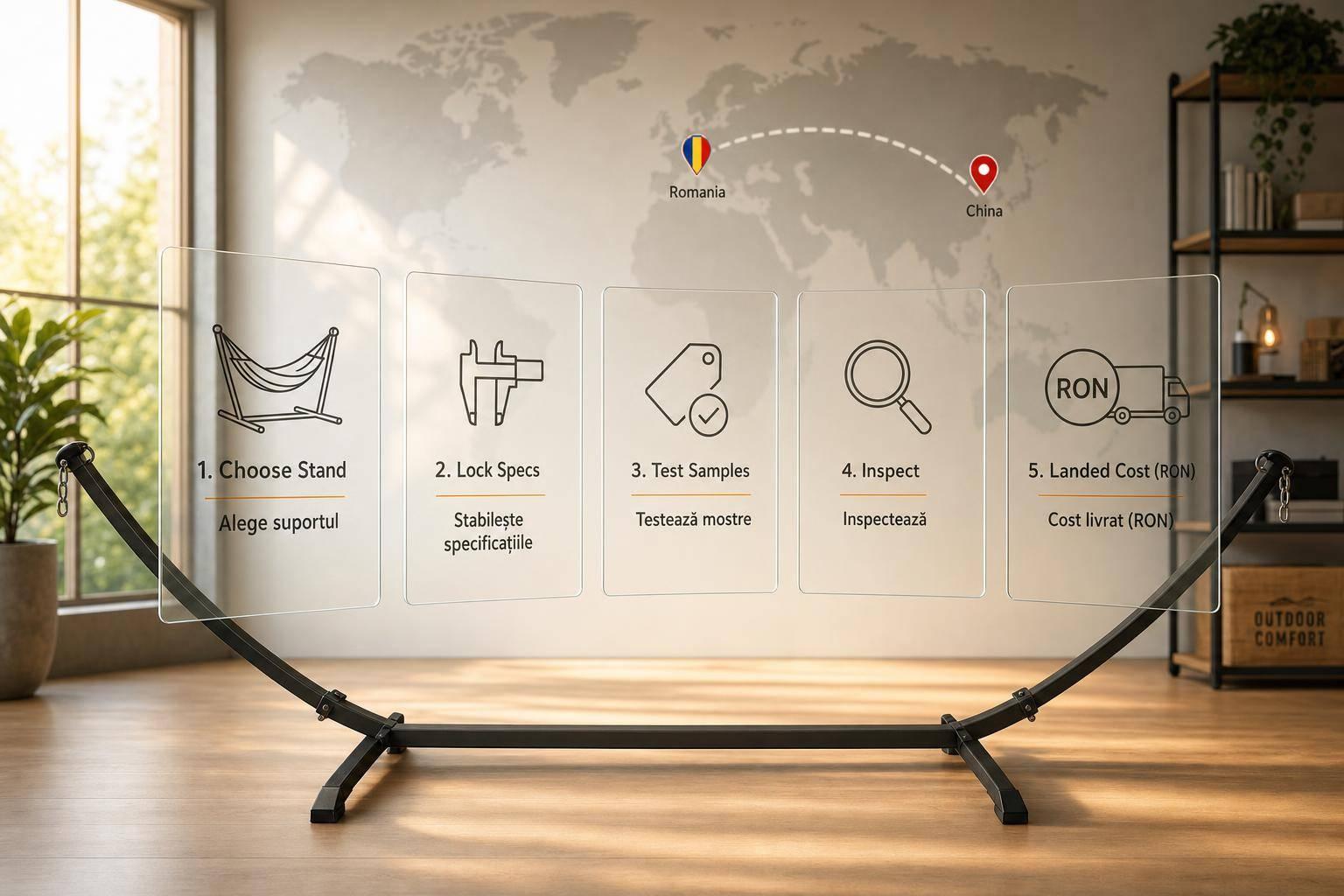
If I source hammock stands from China for a Balkan or Eastern European range, the main job is simple: pick the right stand, lock the specs, test small volumes first, and calculate landed cost in the currency I sell in before I place a larger order. Name the destination in the brief. Serbia, Hungary and the Czech Republic are markets with reviewed buyer evidence on this site. Romania can be the destination as well, as one Eastern European example.
A low unit price is only one part of the deal. I also need to check load rating, coating, carton size, manuals in the destination language and in English, GPSR/REACH fit, inspection, and container loading. A first batch is often discussed around 10 to 200 units. Confirm that quantity on the quotation. A wrong carton size or a weak weld can turn into damage claims, returns, or questions at the border.
Here’s the short version of what I need to get right:
-
Choose the stand type by sales channel
- Steel stands for volume, gardens, terraces, and DIY retail
- Wooden stands for a higher-ticket, furniture-led offer
- Portable/folding stands for camping, balconies, and parcel delivery
- Chair/swing stands for balconies, covered terraces, and indoor use
-
Write the RFQ with numbers, not vague words
- Frame size in cm
- Tube or beam thickness
- Static load in kg
- Coating thickness in µm
- Carton dimensions and weight
- Hardware, colour codes, manuals, and labels
-
Build stand-and-hammock sets
- A simple Good / Better / Best range helps me test price points without adding too many SKUs
-
Run a low-risk buying process
- Prototype sample
- Pre-production sample
- Golden sample
- Test order
- Pre-shipment inspection at 80–100% finished and packed
-
Control what arrives at your warehouse
- One-carton sets for compact models
- Two or three cartons for heavier wooden stands
- Manuals in the destination language and in English
- EAN-13, weights in kg, dimensions in cm, and Made in China marking
-
Work out landed cost in your selling currency
- Add the lines only after duty and VAT are confirmed for the destination
- Include product cost, freight, duty, VAT, and local handling
| Stand type | Best fit | Typical load | Main concern |
|---|---|---|---|
| Powder-coated steel | Webshops, DIY, garden use | 200–250 kg | Rust at welds and tube ends |
| Wooden | Showrooms, premium terrace range | ~200 kg | Heavier packs and more upkeep |
| Portable / folding | Camping, seasonal, courier-friendly sales | 100–150 kg | Lower load on compact models |
| Chair / swing stand | Balconies, covered terraces, indoors | 120–150 kg+ | Must match chair use, not full hammocks |
My takeaway: I should treat hammock stand sourcing as a control process, not just a price search. If I lock specs early, inspect before shipment, and cost everything in the currency I sell in, I can see the risk of weak products, bad packaging, customs delays, and poor sell-through before I commit.
Hammock Stand Types Compared: Load, Use & Sourcing Guide
Not every hammock stand works for every buyer or sales channel. Before you send out the RFQ, it helps to know where each stand format fits best. The stand type affects almost everything you’ll ask for: load rating, frame shape, hardware, and carton size.
Steel, Wooden, Portable, and Chair Stand Formats
Powder-coated steel stands are often the easiest volume product to work into an assortment. They’re usually made from tubular carbon steel with welded or bolted joints, finished with a polyester powder coating that’s typically 60–80 µm thick. Better models can handle 200–250 kg and suit Mayan-style, Brazilian, and spreader-bar hammocks.
For outdoor sale in this region, corrosion protection matters a lot. If the coating is too thin or gets scratched, rust can start around welds and at tube ends.
Wooden stands - most often solid pine or laminated hardwood - give a warmer, more furniture-led look than steel. That’s their main draw. They usually support around 200 kg, but they’re heavier and harder to move than steel frames.
They also need more care. Outdoor wood should be re-oiled or sealed from time to time. And if you’re buying laminated arch designs, the adhesive lines should be rated for exterior use, so they can cope with humid summers and frosty winters, which many buyers in this region plan for. Confirm the exposure your customers actually have.
Portable and folding stands are built for mobility. With collapsible legs and shorter crossbars, they pack into smaller cartons, and some aluminium versions weigh as little as 6–7 kg. Load capacity is often lower: 100–150 kg for compact camping styles, though some heavy-duty folding steel models can go up to around 270 kg.
This is usually the easiest stand type to move through parcel courier networks and to store in tight spaces.
Hammock chair and swing frames are made for single-point hanging chairs, not full-length hammocks. Because they take up less room, they fit well on covered terraces, in indoor reading corners, and on city balconies. Steel versions often carry 120–150 kg, while premium laminated wooden uprights can go higher. Covered placement also reduces corrosion risk.
Use the table below to narrow your RFQ by channel and end use.
| Stand Type | Durability | Maintenance | Weight Capacity | Positioning | Packout Efficiency | Best Use |
|---|---|---|---|---|---|---|
| Powder-coated steel | High | Low | 200–250 kg | Entry-level / functional | High (knock-down) | Gardens, terraces, DIY retail |
| Wooden (solid/laminated) | Medium | High (seasonal oiling) | Around 200 kg | Premium / decorative | Low (bulky arches) | Terraces, holiday homes |
| Portable / folding | Medium | Low | 100–150 kg, with some heavy-duty models higher | Functional / travel | Very high (compact) | Camping, balconies, seasonal |
| Chair / swing | High | Low | 120–150 kg+ | Lifestyle / décor | Medium | Balconies, covered terraces, indoors |
Match Stand Type to Consumer Use and Sales Channel
For online marketplaces and your own webshop, steel knock-down stands and portable models are usually the safest bet. Their carton sizes work better for parcel delivery, and their pricing fits comparison-led shopping. Wooden stands can sell here too, but only if the listing does a good job showing scale, finish, and care needs. Otherwise, buyers may not clock how bulky they are or what upkeep they need.
DIY chains and home improvement retailers usually lean toward sturdy steel garden stands for pallet volume. Wooden stands can sit beside them as higher-ticket display items that help lift basket size. Garden centres and furniture showrooms tend to suit premium wooden stands and design-led chair frames, since shoppers there are often thinking about how a terrace or indoor corner should look. Camping and outdoor stores are a better home for portable and folding formats, along with compact chair frames, especially from April to August.
A simple way to sort the range:
- Use steel for volume and everyday garden use
- Use wood for a more premium look
- Use portable models for seasonal and travel-led demand
- Use chair frames for balconies, covered terraces, and indoor spaces
Those format choices shape the load, footprint, and coating specs you’ll define next.
Turn stand formats into factory-ready numbers. Skip vague phrases. Use the channel priorities from the previous section to tighten the range you want.
The table below is a practical starting point for each stand type, based on realistic EU-market ranges.
| Stand Type | Overall Length (cm) | Height (cm) | Tube / Beam Section | Declared Static Load (kg) | Product Weight (kg) | Carton Size (cm) | Compatible Hanging Length / Seat Drop (cm) |
|---|---|---|---|---|---|---|---|
| Powder-coated steel | 280–320 | 100–130 | Ø42–50 mm, wall 1,5–2,0 mm | 120–200 | 12–18 | ~150 × 30 × 15 | 290–320 |
| Wooden arc (spruce/larch) | 350–420 | 120–150 | Laminated beam 40–60 mm | 150–200 | 20–30 | 2–3 cartons; longest carton up to 210 × 35 × 15 cm | 320–400 |
| Portable / folding steel | 250–300 | 100–120 | Ø32–40 mm, wall 1,2–1,5 mm | 100–130 | 10–14 | ~120 × 25 × 18 | 260–300 |
| Hammock chair stand | Footprint Ø110–130 cm / 100–120 cm front–back | 200–220 | Ø42–48 mm steel or 40–60 mm wood | 120–150 | 12–22 | Longest side ~200–210 | Seat drop 100–120 cm |
Dimensions, Capacity, Stability, and Hardware
For gathered-end hammocks, measure from end loop to end loop, not just the fabric panel. That small detail can throw off the whole fit. For spreader-bar hammocks, list both the bar length and the total length including ropes. Then match that to the stand’s usable hanging length, which should be about 90–110% of the hammock’s total length depending on the sag you want.
With steel stands, tube diameter and wall thickness drive what declared static load is realistic. Entry-level models with Ø38–42 mm tubes and 1,2–1,5 mm walls usually sit in the 100–130 kg range. Mid-range and heavy-duty models need at least Ø42–50 mm with 1,5–2,0 mm walls to reach 150–200 kg with a safe margin. In your RFQ, ask for a static load test result, not just a declared number. A wider base and longer foot span also help cut tipping under side loads.
Specify galvanised or stainless hooks and chains, 6 mm S-hooks, zinc-plated bolts with locknuts or spring washers, UV-stable end caps, and non-slip foot pads.
Materials, Coatings, and Outdoor Durability
For steel stands, specify Q235 grade or equivalent as a minimum. Also ask for outdoor-grade polyester powder coating at 70–90 µm film thickness, with at least 240 hours of salt-spray resistance for mid-range products. Define the colour with RAL codes so online listings and physical samples match. Ask which colours your channel already sells. Anthracite, black, and white are common questions to put on the brief. Ask for continuous welds at load-bearing joints, not spot welds, and smoothed edges to avoid sharp-edge complaints.
For wooden stands, laminated beams are steadier than solid timber and cope better with freeze-thaw winters. Specify 3–5 layers, each 8–12 mm thick, and moisture content at production of 10–14%. Add a UV-resistant topcoat rated for outdoor use. Be plain about intended use: all-season outdoor use, or seasonal use with dry winter storage.
Build Good-Better-Best Sets
A tiered range gives you room to move across sales channels without blowing up your SKU count. The idea is simple: pair the same stand type with different hammock materials and accessory levels to create three price points: Good for volume, Better for retail uplift, and Best for premium display.
- A Good set uses a standard powder-coated steel stand with a basic hammock.
- A Better set upgrades the hammock fabric and packaging.
- A Best set moves to a heavy-duty steel or laminated wood stand with stainless hardware, retail-ready packaging, and a local-language assembly manual.
When planning combos, define colours with RAL codes so the stand and hammock stay matched across assortments. Shipping Good, Better, and Best sets in the same container lets you test all three tiers in one RFQ cycle, spread landed cost across price points, and adjust reorder ratios based on actual sell-through.
Use these specs as the RFQ baseline before you request samples and test orders.
Once your specs and combo tiers are set, the next move is simple: turn that paperwork into a process a factory can actually follow. The aim is to check quality and market demand at a low cost before you commit to full container volumes.
Prepare RFQs, Samples, and Test Orders
Treat the RFQ as the master spec sheet for samples, production, inspection, and repeat orders. It should lock in the stand type, overall dimensions, target hammock length, load rating, material, finish or colour, accessory set, packaging style, carton marks, manual language, and your target price band. You should also state the sales channel. An e-commerce-ready product often needs tighter packaging and clearer assembly instructions than a bulk wholesale version. Ask if the supplier can quote and ship mixed SKUs in one order.
Use three sample stages: prototype, pre-production, and golden sample.
- The prototype checks whether the product can be made as planned.
- The pre-production sample locks in the final materials and hardware.
- The golden sample becomes the buyer-approved reference unit for production and inspection.
When a sample arrives, assemble it the same way a customer would, using only the tools and instructions in the box. That’s where problems tend to show up. Wobble, poor welds, uneven coating, or missing hardware often look fine on a factory bench, then fall apart during actual assembly. For an EU retail channel, also confirm that manuals and safety notes can be produced in the language the destination requires. Romanian is one example when Romania is the destination.
Structure test orders by SKU, usually 10 to 200 units per variant. Once samples pass, move straight into PSI and load testing.
Check Load Testing, Assembly Safety, and Inspection Points
Schedule your pre-shipment inspection (PSI) when 80–100% of the goods are finished and 80–100% are packed. Pull samples at random across pallets and production batches, not just from the top layer. That part matters. If you only inspect what’s easiest to reach, you can miss batch-level issues.
The inspection should check:
- Correct dimensions
- Parts count
- Hardware completeness
- Weld quality
- Coating defects
- Carton condition
- Full assembly
If assembly needs improvisation or parts are missing, reject the batch.
For load and safety checks, ask for static load test evidence, not just a stated number on a spec sheet. Verify that the structure stays aligned after loading and unloading. Check for sharp edges, pinch points, and exposed burrs at joints. Also confirm tipping resistance under side-load testing. For EU market entry, hammock stands should comply with the General Product Safety Regulation (GPSR) and REACH chemical restrictions; non-compliant products can be rejected at the border or withdrawn through Safety Gate.
A useful inspection package should include an inspection report with defect counts, photos of assembled units, carton photos, and a clear defect classification. Use the PSI report as your release gate: approve shipment, request rework, or hold, based on evidence, not trust.
After PSI approval, move to carton rules, manuals, and loading checks before payment release.
Carton Rules, Labels, and Local-Language Manuals
For compact sets, use one carton per set. For heavier wooden stands, split the product into two or three cartons. That cuts handling risk and makes stacking safer.
Inside the carton, add protection that fits the product:
- Foam or cardboard corner protectors for metal tubes and wooden beams
- Polybags or shrink wrap to help prevent scratches
- Labelled inner boxes for hardware sets
- Anti-rust bags or desiccant packs for metal parts meant for outdoor use
Each outer carton should show gross and net weight in kg - for example, "G.W. 22,5 kg / N.W. 20,0 kg" - plus dimensions in cm, using the number format your warehouse already uses. Many Balkan and Eastern European documents use a comma for decimals and a dot for thousands. Add handling marks such as "This Way Up", "Fragile," and "Stacking Limit", sized to match the carton panel. Use EAN-13 or a similar barcode on retail boxes and, when needed, outer cartons in a fixed position. Print "Made in China" where it can be seen on both retail packaging and shipping cartons.
Assembly and safety manuals should be printed in the destination language and in English. Include step-by-step diagrams, required tools, max load in kg, stability checks, warnings, and winter storage notes. The importer name and EU contact address should appear on the manual or packaging where your destination requires them. Confirm with NINGBO YUFEI, or the factory, whether this order will include destination-language manuals and whether barcodes, material-identification codes, recycling symbols, and importer fields will be printed on the carton. That print scope is an order-specific confirmation.
Container Loading, Mixed Assortments, and Landed Cost
Once carton specs are fixed, turn those numbers into CBM, stacking order, and freight cost. After carton dimensions are finalised, use them to plan pallet rows and stack height. Carton size will depend on stand type and weight, so heavier wooden stands should go at the bottom, with lighter metal frames on top.
Use the container's internal dimensions to work out how many cartons fit in each floor row and how many layers can be stacked safely. Straps, corner posts, and dunnage should brace every stack, and any empty space that could let cartons move during transit should be filled.
For mixed assortments, group SKUs by type in a zoning plan and match that same plan in the packing list. Every carton should show a SKU code, product description, variant details, and a batch or carton ID. The packing list should include HS codes, quantities, net and gross weights, and CBM per SKU line, plus a shipment summary at the bottom. Ask for loading photos and the seal number after loading.
For landed cost planning, bad carton weights or CBM figures will skew both freight and VAT planning. In plain terms, if the input data is off, the costing model is off too. You need clean figures from the supplier. A blank model, using the comma-decimal format common on invoices in this region, looks like this. The letters are placeholders. Fill them from the quotation and from your broker:
| Cost Component | Amount |
|---|---|
| Product + freight + import duty | A — from the invoice and the broker |
| Import VAT (confirm the rate and whether the base includes customs value, freight, insurance and duty) | B — from your broker |
| Domestic handling and last-mile distribution | C — from your forwarder |
| Total landed cost per unit | A + B + C, in the currency you sell in |
It also helps to model a few versions of the same shipment using different freight rates and duty classifications before you set retail prices.
Conclusion: Key Checks Before You Place a Hammock Stand Order
Before you confirm the order, review four areas.
On packaging and manuals: check carton size and weight limits, internal protection, markings, manuals in the destination language and in English, load warnings, and importer details.
On loading and logistics: review the CBM plan and loading diagram, request loading photos and seal number after loading, and match packing list SKU codes with your warehouse receiving system.
On EU destination compliance: confirm, for your destination, whether packaging EPR registration and labelling duties apply, and who holds them. Make sure customs paperwork includes the HS codes your broker has confirmed, origin, and a full packing list, and confirm how import VAT is accounted for. The rate and the registration are confirmation items for that destination.
Clear specs, controlled testing, and disciplined execution across the full sourcing flow - specs → samples → inspection → cartons → loading → landed cost - are what separate a smooth import cycle from one full of damage claims, customs delays, and marketplace complaints.
How do I choose the right stand for my sales channel?
Match your hammock stand to seven core checks: supplier legitimacy, product specs, MOQ, pricing, packaging, QC, and shipping.
If you sell online, put extra weight on retail-ready, scan-compliant packaging with clear barcodes and manuals in the destination language. That can cut warehouse handling work and help lower returns.
Ask NINGBO YUFEI, or the factory, whether this order can share a container, what the minimum is per SKU, and who books the pre-shipment inspection. Confirm each point for this order.
What should I test before placing a larger order?
Before you place a larger hammock stand order, get the basics confirmed in writing. That means supplier legitimacy, product specs, MOQs, pricing, packaging, quality control standards, and shipping requirements.
Don’t skip samples. They give you a clear way to check build quality, finish, and whether the product matches the agreed specs. It’s also smart to verify the retail packaging, barcodes, and manuals in the destination language at this stage, before the goods are packed for departure.
Then book a pre-shipment inspection when production is 80 to 100 percent complete. At that point, most of the order is done, so you can spot issues before the shipment goes out. Confirm who carries out any SKU check and what the inspection report will include before you treat it as a release.
How do I calculate landed cost in my selling currency?
Add the product price, international shipping, insurance, import duties, and local transport costs. Then convert the total into the currency you sell in, using the rate your bank or broker will actually apply. If Romania is the destination, buyers often check the daily rate from the National Bank of Romania and then confirm the rate on the payment date.
Use the number format your invoices already use. Many buyers in this region write amounts as 1.250,50, with a dot for thousands and a comma for decimals. If you sell in RON, that is the currency to show. Confirm the rate rather than copying an example.
To keep margins accurate, make sure freight rates and customs fees can be updated easily as they change.