
Buyer guide
7 Camp Kitchen Organizer Features Buyers Check
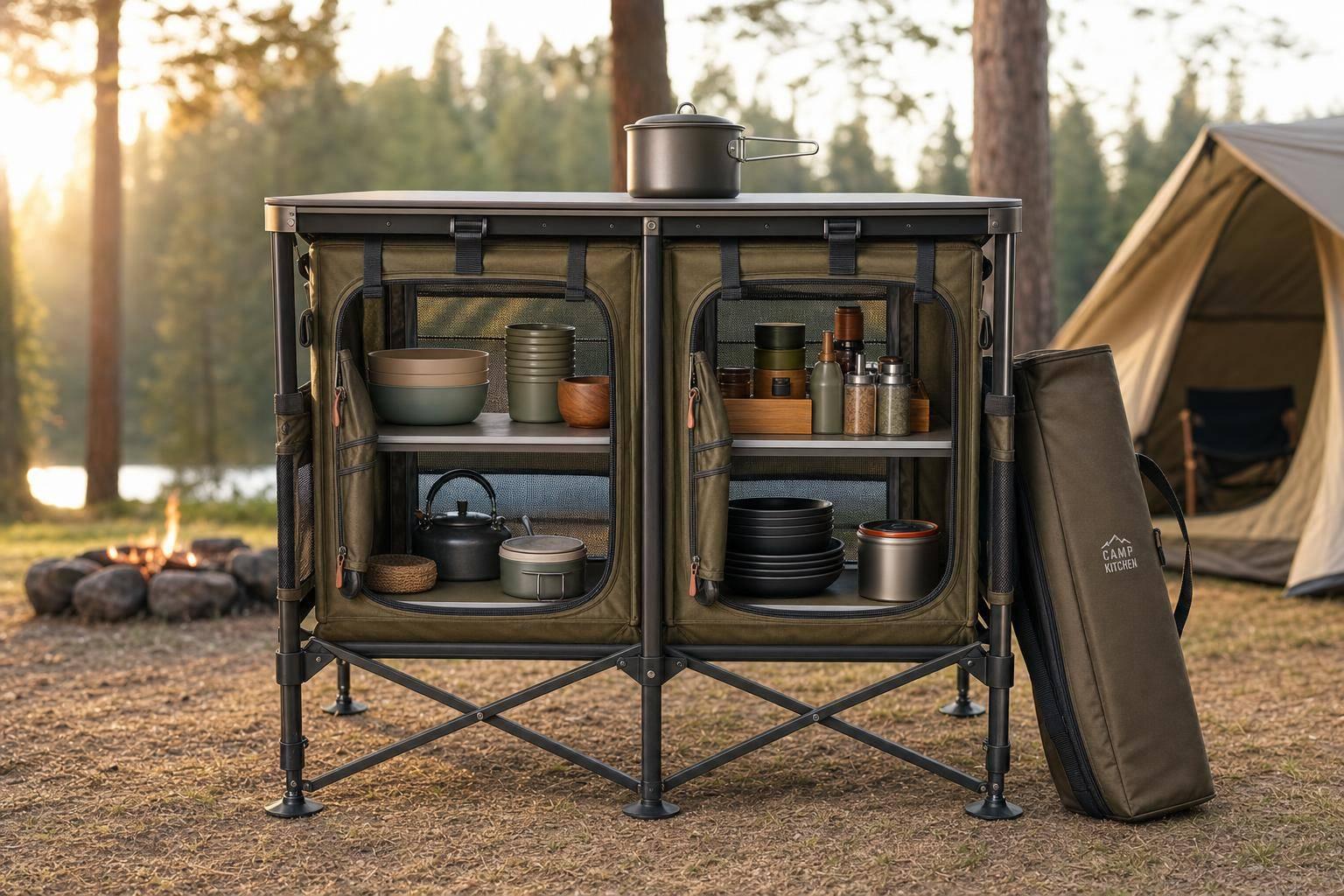
If I were buying a camp kitchen organiser today, I’d check 7 things first: frame, fabric, shelves, folded size, carry bag, load limits, and cleaning. That short list tells me if the unit will fit in the car, hold normal camping gear, and survive regular use.
For buyers in the Balkans and Eastern Europe, I’d keep the first checks simple and measurable. Romania can be the destination, as one example. Serbia, Hungary and the Czech Republic are markets with reviewed buyer evidence on this site.
- Folded size: can it fit in the boot?
- Net weight: can one person carry it?
- Shelf depth: does it hold plates, pots, and 1 L boxes?
- Written load limit: is the shelf and worktop capacity stated in kg?
- Materials: aluminium alloy frame, 600D Oxford cloth, wipe-clean panels
- Packed data: carton size, G.W., and freight info
- Care notes: how to clean, dry, and store it after wet use
A common double-bay model opens to 120 × 49 × 88 cm, folds to 61 × 30 × 53,5 cm, and weighs about 9,5 kg N.W. / 10,5 kg G.W. Those numbers matter more than sales copy.
7 Camp Kitchen Organizer Features: What to Check Before You Buy
| Check | What I’d look for | Why it matters |
|---|---|---|
| Frame | Aluminium alloy, tube size in mm, clean joints | Less shake, longer use |
| Fabric | 600D Oxford cloth, zip details, neat seams | Fewer tears and zip issues |
| Shelves | 3–5 shelves, 28–30 cm internal depth | Fits normal cookware better |
| Folded size | Packed size in cm | Boot fit and storage |
| Carry bag | Reinforced handles and base | Safer lifting and transport |
| Load limits | Shelf and worktop rating in kg | Safer use with heavier gear |
| Cleaning | Wipe-clean surfaces, moisture-resistant finish | Less mess after camp use |
My rule is simple: if a supplier does not show folded size, net weight, materials, and written load ratings in one spec sheet, I treat the listing as incomplete.
Below, I’d use these seven checks to compare models side by side before spending in the currency you sell in.
Many buyers in this region are packing a campsite trip into one car, so boot space gets tight fast. That’s why folded size and packed weight matter so much. Ask for the folded size and the weight. One quotation may show about 61 × 30 × 53,5 cm and 9,5 kg. Measure the sample before you decide it fits next to tents, sleeping bags, cooking gear, and food.
After that, it makes sense to look at how well the frame and fabric deal with normal campsite use.
Campsites in this region can mean damp mornings followed by hot summer afternoons, so material choice matters a lot. Buyers often ask for stable aluminium alloy frames, 600D Oxford cloth, and moisture-resistant powder-coated parts that can handle uneven ground and changing weather. Confirm those materials on the sample. Those material choices also shape how much effort cleaning takes later.
Density board panels and powder-coated worktops wipe clean fast, which makes them a good fit for outdoor food prep.
It also helps when listings show dimensions in centimetres, weight in kilograms, and heat tolerance in °C. That makes it easier for buyers to judge if the organiser suits what they need.
Aluminium alloy is usually the first thing buyers look at when they assess a camp kitchen organiser. The main checks are the alloy grade, tube thickness, and how well the joints fit.
That said, don’t stop at the material alone. The way the frame is built matters just as much. Tube alignment is one of the first things to inspect. If the tubes aren’t lined up with care, the frame can feel shaky right out of the box and may become less reliable over time.
Joint quality also matters as much as material choice. Before you place a bulk order, ask for close-up photos of the tube joints. Also ask which frame materials the supplier regularly processes in-house. That small check can tell you a lot about day-to-day production control.
For retail-ready documentation, the product specs should clearly show:
- alloy grade
- tube dimensions in millimetres (mm)
- net weight in kilograms (kg)
- packaging inclusions for a standard double camp kitchen unit
In short, list alloy grade, tube dimensions, net weight, and packaging contents in the spec sheet.
Once the frame passes, check fabric strength and zip hardware.
After the frame, buyers usually look hard at the fabric. And for good reason. A high-quality portable camp kitchen organizer will often use 600D Oxford cloth.
If you're sourcing in bulk, don't settle for a vague material line in the quote. Ask for the denier, weave, and zipper specs up front. That saves a lot of back-and-forth later.
One thing people often miss? Seam finishing and panel fit. A product can look fine in photos and still fall apart at the edges after light use. Check seam finishing, edge binding, and stitching consistency to cut down on fraying. You should also ask the supplier to state the zipper type, tooth size, and puller material in the quote.
For product listings, the spec sheet should clearly record these fabric and hardware details:
| Component | Recommended Specification |
|---|---|
| Fabric Type | 600D Oxford cloth |
| Fabric Weight (g/m²) | Weight in grams per square metre |
| Zip Hardware | Heavy-duty zipper, reinforced puller |
| Moisture-Resistant Coating | Coating or treatment applied |
Next, check shelf design and internal layout.
Once you've checked the fabric and zips, most buyers go straight to the shelves. And that makes sense. Shelf count and shelf depth decide what the organiser can actually hold at camp. That should be your first check, even before folded size.
For car campers in this region, 3–5 shelves is the range many buyers ask about. Confirm the shelf count against the use your customers actually have. Go past 6 shelves and you need to look much more closely at shelf depth and height. On many units, once shelf count goes above 6, the usable depth starts to shrink.
Shelf depth is where plenty of buyers get tripped up. A cabinet can look roomy from the outside, then turn out to have internal shelf depths of only 20–22 cm. That makes larger items sit sideways and leaves awkward dead space. A minimum usable internal shelf depth of 28–30 cm works for standard dinner plates (Ø 26–28 cm), medium pots (20–24 cm diameter), and 1 L food boxes. If you want more room for bulkier cookware, 32–35 cm gives you extra breathing space. Check that the spec sheet shows the internal shelf depth in centimetres, not just the cabinet's outer depth.
The internal layout also changes how the organiser feels when you're actually cooking. A two-column layout makes it easier to split heavy gear, like pots or a gas stove, from lighter dry food and tableware. That helps with balance and can cut the tipping risk when a door is open. If you often pack a 5 L water bottle or a tall pot, look for at least one compartment with 40–45 cm of internal height on the spec sheet.
For B2B buyers sourcing at scale, overall dimensions aren't enough. Ask for:
- Internal shelf width, depth, and height in centimetres
- Whether shelves are fixed or adjustable
- Shelf material, such as rigid MDF board, aluminium slats, or a fabric base
- The load rating per shelf
A clear front-view diagram of shelf positions also helps. It lets buyers judge the open space for bulky items at a glance instead of just counting compartments.
These details should appear clearly on the spec sheet.
| Shelf Spec Detail | What to Look For |
|---|---|
| Internal shelf depth | Minimum 28–30 cm; ideally 32–35 cm for larger cookware |
| Compartment height | 25–30 cm per level; 40–45 cm for at least one tall section |
| Shelf material | Rigid MDF board or aluminium slats, especially for heavy jars and canned food |
| Adjustability | Fixed or adjustable; note number of positions and increment in cm |
| Load rating per shelf | Stated in kg per level |
Next, check folded size and packed weight, because even a smart shelf layout doesn't help much if the unit won't fit in the car.
A camp kitchen organiser might look great when it's set up. But if it can't fit in the car boot with the rest of your camping gear, that layout doesn't help much. That's why boot fit should be one of the first checks. The same goes for warehouse planning.
One detail buyers often overlook is the gap between product size and packed size. They are not the same thing. Product size tells you how much space the unit takes up when open. Packed size tells you the carton size you actually load into the car. And that's the number that matters for storage and transport.
Take a standard double-bay unit. It can measure 120 × 49 × 88 cm when fully assembled, but fold down to 61 × 30 × 53,5 cm when packed. For boot space planning, that folded size is the one to watch.
Weight works the same way. Net Weight (N.W.) is the organiser itself - the part the camper lifts and carries. Gross Weight (G.W.) adds the carry bag and outer packaging. Even a 1 kg difference can affect freight cost and handling.
For B2B buyers placing volume orders, the spec sheet should also show CBM (Cubic Metres) and container loading data. That figure makes mixed-container planning much easier.
| Metric | Example (Standard Double-Bay Unit) | What It Affects |
|---|---|---|
| Product Size (open) | 120 × 49 × 88 cm | Workspace footprint at camp |
| Packed Size (folded) | 61 × 30 × 53,5 cm | Boot space and storage fit |
| Net Weight (N.W.) | 9,5 kg | Portability for the end user |
| Gross Weight (G.W.) | 10,5 kg | Shipping tier and handling |
If a product page only shows assembled dimensions, it leaves out half the story. Buyers need the full set of core specs: folded size in cm, both weight figures in kg, and CBM for bulk orders. That's how you plan properly before placing an order.
After size and weight, the next thing to check is the carry bag and handles that protect the packed unit in transit.
Once the packed size looks right, inspect the carry bag next. This part matters more than many buyers expect. The bag needs to stand up to repeated lifting, loading, and unloading between the car and the campsite. It shouldn’t just hold the unit in storage. It needs to protect it during regular handling.
For most buyers, 600D Oxford cloth is the material standard to check for. If the unit is on the heavier side, the handles and base should be reinforced to match the packed load. Otherwise, the bag may fail where it takes the most stress.
Then look at the sewing and cutting. Seam alignment, edge finishing, and stitching quality tell you a lot about how well the bag was made. Poor cut accuracy or crooked seams usually point to weak textile control.
Before any order is placed, get the carry bag specs confirmed in writing. The spec sheet should clearly state:
- the bag material and denier
- that the handles and base are reinforced for the packed load
- approval photos, including packed-product and carton photos
Also confirm in writing that the bag material, reinforcement, and carton photos match the approved sample.
After the bag passes, check load limits and worktop capacity.
After the frame, fabric, and shelf layout, load capacity is the safety check. Per-shelf load ratings and worktop load limits should be stated clearly in the spec sheet, not hinted at through material descriptions. A solid frame alone isn’t enough; buyers need written load limits for each shelf and the worktop.
Even a rigid density-board worktop still needs a written load rating. And if the surface area is larger, it may need a higher load limit to help prevent sagging in the middle.
Ask the supplier to confirm the worktop and shelf load limits in both the quotation and the spec sheet. Then test the sample under weight and check:
- tube alignment
- fabric tension
- frame stability
After load limits, check how easily the unit cleans up after wet or greasy use.
Next, look at two practical things: how easy the unit is to clean and how well it handles damp or wet conditions.
Start with smooth, wipe-clean surfaces. Aluminium alloy, HDPE, and powder-coated metal are easy to wipe down and hold up well in damp conditions. Density board is a different story. It needs sealing or lamination to help prevent moisture damage.
For the fabric body, many buyers look for 600D Oxford cloth with a water-repellent coating. It’s also worth checking the small build details. Clean cutting and aligned seams can help limit water entry and reduce fraying. And those details shouldn’t live ONLY in product photos. They should be listed in the product spec too.
If you're placing a bulk order, get the cleaning notes confirmed in writing. The manual should clearly explain wipe-clean steps, drying time after rain exposure, and storage guidance. Also check whether the fabric panels can be removed for washing.
These checks tie straight into the spec fields you’ll review next: surface material, coating type, panel removability, and care instructions.
| Material | Cleaning Ease | Moisture Resistance | Notes |
|---|---|---|---|
| Aluminium Alloy | High | Excellent | Recommended for worktops and frames |
| HDPE/Resin | High | Excellent | Recommended for prep surfaces |
| Powder-Coated Metal | Medium | Good | Useful for frames and worktops |
| Density Board | Medium | Low to Moderate | Requires sealing or lamination |
Once you’ve checked the product itself, the next step is simple: turn those findings into a spec sheet buyers can scan fast and compare with almost no effort. Use the same format every time and publish these seven checks: size, frame, fabric, shelves, load, care, and logistics.
For ecommerce listings in this region, show dimensions in centimetres and weights in kilograms. Put open size, packed size, N.W., and G.W. together in one spec line so the key numbers are easy to spot. Then add the frame tube material and diameter in mm, the fabric denier, the number of shelves, the per-shelf load limit in kg, and the tabletop load capacity in kg.
Skip fuzzy labels like “durable fabric” and “strong frame.” They sound nice, but they don’t help a buyer compare one model with another. And when people can’t compare fast, orders tend to slow down.
Before the order is placed, confirm the product version, branding, packaging, carton marks, quantity, inspection, and delivery terms. Put care instructions and container-loading data in the same spec pack too. If you include units per 40HQ, B2B buyers can plan freight right away instead of sending extra emails.
A good rule is to use one line per model. That way, buyers can scan size, weight, capacity, and logistics at a glance.
Use these core fields in every listing:
| Spec Category | Data Point to Publish | Example Value |
|---|---|---|
| Open Dimensions | Length × Width × Height (cm) | 120 × 49 × 88 cm |
| Packed Dimensions | Folded/carton size (cm) | 61 × 30 × 53,5 cm |
| Weight | Net Weight / Gross Weight (kg) | 9,5 kg / 10,5 kg |
| Frame | Material and tube diameter (mm) | Aluminium alloy tube frame |
| Fabric | Material and denier | 600D Oxford cloth |
| Shelves | Number of shelves | Stated per model |
| Capacity | Per-shelf load + tabletop load (kg) | Stated per model |
| Logistics | Units per 40HQ container | 680 pcs |
| Documentation | Care instructions + assembly manual | Included in carton |
If a buyer can read one row and know the size, weight, material, load, and shipping count, the listing is doing its job.
Use the seven checks above to line up supplier quotes side by side. If you're buying for this region, the first things to verify are folded size, N.W., and the written load limit. Those three details tell you a lot, fast: will it fit in the car boot, is it easy enough to carry, and can it handle the weight you plan to put on it?
The table below uses NINGBO YUFEI's high double-bay camp kitchen organiser as a sample for quick comparison.
| Feature | Example Spec | Buyer Action |
|---|---|---|
| Frame Material and Finish | Aluminium alloy tube / steel | Check stability and rust resistance. |
| Fabric Rating | 600D Oxford cloth | Check tear resistance. |
| Shelf Type | Rigid MDF board | Check rigidity and moisture exposure. |
| Size (open / folded packing) | 120 × 49 × 88 cm / 61 × 30 × 53,5 cm | Check boot fit and work space. |
| Weight (N.W. / G.W.) | 9,5 kg / 10,5 kg | Check carry load and freight handling. |
| Load Capacity | Per-shelf and tabletop load rating in kg | Check written kg rating. |
| Cleaning and Moisture Resistance | Wipe-clean fabric; moisture-resistant finish | Check wipe-clean surfaces and moisture resistance. |
If a quote leaves out the kg rating or the folded-size data, treat it as an incomplete spec. That's usually a sign you need to ask follow-up questions before you compare price or place an order.
A camp kitchen organiser is worth buying only when the spec is clear and complete. These checks tell you if the unit can handle actual campsite use. That’s the line between a piece of gear that helps and a weak product listing.
For buyers in this region, the main things to check are fit, portability, and easy cleaning. Every quote should include folded dimensions, net weight, and written load ratings in kg.
NINGBO YUFEI's sourcing team says supplier communication and sample quality matter just as much as price.
Before you place a bulk order, test a sample for tube alignment, fabric cut quality, and shelf stability. If a supplier can’t give you a full written spec for all seven checks before price discussions, walk away.
How much shelf depth do I really need?
For a camp kitchen organiser, 40 to 50 cm is usually the sweet spot. It gives you enough room for standard cooking gear and helps keep the unit steady while you cook.
If you use larger cookware, aim for 45 to 50 cm. That size tends to work best for pots, pans, and organisers without making the unit awkward to carry or set up outdoors.
What load rating is safe for normal camping gear?
For standard camping kitchen organisers, a safe load rating for the main work surface is usually 20 kg to 30 kg. That’s a good rule of thumb, but the exact figure can vary, so check the technical specifications before you buy.
This matters more than it may seem. A camping kitchen often ends up holding heavier kit than expected, like a stove, pots, food boxes, or water containers. If the frame or worktop isn’t built for that weight, things can go wrong fast.
Pay close attention to the frame and overall build. It should support the gear you plan to use, especially heavy cooking stoves or water containers.
If you’re sourcing through NINGBO YUFEI, ask for the weight limits in writing during the specification stage. That gives you a clear record of what the product is meant to handle.
How do I store it after wet use?
After using it in wet conditions, clean it and dry every part fully before putting it away. Wipe all surfaces, and make sure the fabric is completely dry. That helps stop mould and helps the unit last longer.
When everything is dry, fold it as instructed and place it in the included carry bag. Store it in a dry, sheltered spot.