
Buyer guide
China Foldable Camping Organizer Supplier Guide
On this page
- Verify Business Scope, Product Range, and Factory Capability
- Use a Factory Checklist for Stitching, Frames, and Folding Function
- Confirm Inspection Records and Documents Before Shipment
- Set MOQ by SKU, Colour, and Total Order Mix
- Approve Samples in Stages to Avoid Bulk Mistakes
- Compare Private-Label and Generic Orders Before Committing
- Select Fabric and Frame Materials for Durability and Price
- Match Design Specs to Camping and Car-Storage Use
- Compare Material Options and Packaging Formats
- Plan Cartons, Labels, and Shipping Method Early
- Use Mixed-Container Planning and Pre-Shipment Controls
- Conclusion: The Checklist Buyers Should Confirm Before Ordering
- How do I verify a supplier is a real factory?
- When should I choose generic or private-label orders?
- What should I test before approving bulk production?
If I want to buy foldable camping organisers from China with lower risk, I need to lock five things first: specs, factory checks, samples, MOQ, and shipping.
A bulk order can go wrong fast when the sample does not match mass production, when MOQ is set the wrong way, or when the landed cost in EUR and the currency you sell in is off by even a small margin. In this guide, I focus on the parts that matter most for Balkan and Eastern European buyers. Romania can be the destination, as one example. Serbia, Hungary and the Czech Republic are markets with reviewed buyer evidence on this site. The checks use cm, kg, litres, and °C, checking supplier capability before price talks, testing samples in stages, and matching packaging and freight to my sales model.
Here’s the short version:
- I define the product scope early so quotes match the same item.
- I check whether the supplier can sew fabric parts and assemble metal frames.
- I test samples for load, wobble, and folding cycles, not just looks.
- I confirm MOQ by SKU, colour, and total order mix.
- I compare generic vs private-label orders before I commit.
- I check carton size, gross weight, labels, and LCL/FCL plans before shipment.
A few questions to put on the quotation:
- Does MOQ apply per colour, and is a figure around 300–500 pcs per colour per SKU what this factory quotes?
- Can a mixed order use a lower quantity, sometimes discussed around 100–200 pcs per SKU?
- What is the sample fee, and what does a three-stage sample cycle cost for this order?
- What is the lead time for a generic item, and what is it after a custom sample is approved?
Those quantities, fees and days are questions. They are not a Ningbo Yufei price, minimum or lead time.
Quick comparison
| Area | What I check | Typical range |
|---|---|---|
| MOQ | Per SKU / per colour / mixed order | 100–1.000 pcs |
| Samples | Existing / PP / packaging | 4–8 weeks |
| Unit cost | Generic vs private-label | Ask for both prices on the quotation |
| Shipping | LCL / FCL / mixed container | Depends on volume |
| Carton | Folded packed size | Around 61 × 15 × 53,5 cm |
The main point is simple: I lower risk when I treat sourcing as a numbers-and-process job, not just a price search.
Check the factory first. Price only starts to matter once you know the supplier can actually make the product you need.
After that, make sure the factory produces this product category in-house.
Verify Business Scope, Product Range, and Factory Capability
Start with the basics. Does the supplier’s registered business scope cover foldable camping organisers and the fabric-and-frame processes involved?
Factories that make products themselves often keep key steps in-house. So ask for factory photos that show the actual production lines. For foldable camping organisers, that usually means sewing lines for the fabric parts and assembly lines for the metal frames.
It also helps to look for suppliers with hands-on experience in the same material mix. Aluminium and steel are not the same thing here, and they shouldn’t be treated as interchangeable.
You can also use carton dimensions and 40HQ loading plans as a reality check. If the loading plan doesn’t line up with the quoted volume and timeline, the lead time may not hold up under pressure.
Then move from photos to samples. That’s where you find out what the factory can actually deliver.
Use a Factory Checklist for Stitching, Frames, and Folding Function
Test samples for load capacity, folding cycles, and wobble. Don’t judge them on appearance alone.
A practical six-point checklist should cover:
- frame fit
- screw alignment
- folding action
- load testing
- wobble checks
- finish quality
| Check Category | Specific Inspection Points |
|---|---|
| Structural integrity | Frame fit, screw alignment, load testing, wobble checks |
| Mechanical function | Folding action performance, folding-cycle consistency |
| Fabric and finish | Fabric cutting accuracy, tube alignment, fabric coating consistency, overall finish |
| Carton grade and marking accuracy | 5-layer corrugated boxes, carton marking accuracy |
This kind of check helps you spot problems early. A sample can look fine in a photo and still fail once you fold it ten times or put weight on it.
Confirm Inspection Records and Documents Before Shipment
Before paying the balance, ask for a pre-shipment inspection (PSI) report. It should include dated production photos, a packing list, and container loading updates, so you can confirm the goods match the approved sample.
Put dated milestones in the purchase order as well. Sample sign-off, mid-production inspection, and PSI completion should all be clearly listed if you want the schedule to stay tight.
Where relevant, ask for ISO 9001 compliance records and CE certificates linked to the right product directives. NINGBO YUFEI also provides pre-shipment inspection support, product photos, packing list support, and loading updates.
Once the factory passes PSI, lock MOQ and sample stages before final price approval. With factory capability confirmed, the next step is MOQ, sample approval, and costing.
Generic vs Private-Label Camping Organizer Orders from China: Key Differences
Next, set MOQ, samples, and pricing in a way that matches how you plan to sell.
Set MOQ by SKU, Colour, and Total Order Mix
MOQ for foldable camping organisers isn't always one flat number. A factory may apply it per model, per colour, or across a mixed total order. That detail matters, especially when you're watching cash flow.
For sewn camping organisers with steel or aluminium frames, many mid-size Chinese factories quote 300–500 pcs per colour per SKU. Some more flexible suppliers may go as low as 100–200 pcs per SKU if your total order across several camping items reaches 500–1.000 pcs. A mixed-SKU plan can help you split MOQ across colours while still using container space in a 20 ft or 40 ft shipment to your entry port. Confirm the minimum on the quotation.
Custom elements change the maths. A logo print or embroidery, a printed retail box, or a bilingual manual in English and the destination language can change the MOQ, because printers and packing lines work better with longer runs. Buyers sometimes hear a jump from 200–300 pcs toward 500–1.000 pcs per design. Ask how setup costs for plates and artwork are charged on this order. Do not budget a per-unit print fee from this article.
Once MOQ is clear, the next step is to fix the sample stages before you approve the final price.
Approve Samples in Stages to Avoid Bulk Mistakes
A three-stage sample process gives you clean checkpoints before mass production begins.
- Existing sample: Check overall dimensions in centimetres, folding method, pocket layout, frame stability, and stitching quality. Put every requested change in writing.
- PP sample: Confirm that the changes were made. Measure key dimensions, test load capacity (8–12 kg for car storage), and inspect frame thickness and folding action. If you're using private-label, confirm logo position here. Record every deviation with photos.
- Packaging sample: Review colour box layout, artwork accuracy, barcode scannability (EAN-13), and bilingual text in English and the destination language. If Romania is the destination, check the Romanian text for grammar and label accuracy. Another destination needs its own language check.
Ask what the factory charges per sample, what the courier to your destination costs, and how many weeks a three-stage cycle takes for this product. Put those figures on the quotation. This article does not state a sample price or a courier rate.
After sample approval, compare the material and packaging specs against your target price.
Compare Private-Label and Generic Orders Before Committing
Choosing between private-label and generic supply affects MOQ, lead time, flexibility, and your landed cost in EUR or the currency you sell in.
Generic orders use existing factory designs with very little custom work. They come with lower MOQs, shorter lead times, and less per-unit risk. That makes them a good fit when you want to test a new organiser model without tying up too much stock. Private-label orders include custom packaging, branding, and bilingual documentation. That pushes MOQ up and stretches lead time, but it can give you stronger shelf presence and better margin in wholesale and retail.
Here’s the side-by-side view:
| Feature | Generic / Stock Orders | Private-label / custom orders |
|---|---|---|
| MOQ | 100–300 pcs per SKU | 500–1.000 pcs per SKU/colour |
| Lead time | Ask for the lead time, and whether it depends on goods the factory already holds for this order | 45–75 days after sample approval |
| Ex-factory unit cost | Ask for the ex-factory price on this quotation | Ask how custom packaging changes that price |
| Best suited for | SKU testing, price-competitive markets | Brand-building, wholesale retail channels |
For e-commerce sellers in this region, a mixed setup is often the question to test: use private-label for the SKUs you already sell, and use generic supply to test niche organiser sizes or new colour variants. That way, you keep capital exposure under control while still building brand recognition where it matters most. The order model you pick will also shape which material grades and retail packaging formats make sense in the next section.
Once your order model is set, pin down the material specs and packaging format before bulk production begins. These choices shape product life, freight spend, and how well the item performs once it lands with retailers or in e-commerce warehouses in your market.
Select Fabric and Frame Materials for Durability and Price
Go with 600D Oxford cloth and aluminium alloy tubing if you want a strong balance between durability and price.
If the organiser needs internal shelving, use density board panels. They create a firm surface for storage and help prevent sagging.
After you fix the base materials, move on to dimensions and folding points.
Match Design Specs to Camping and Car-Storage Use
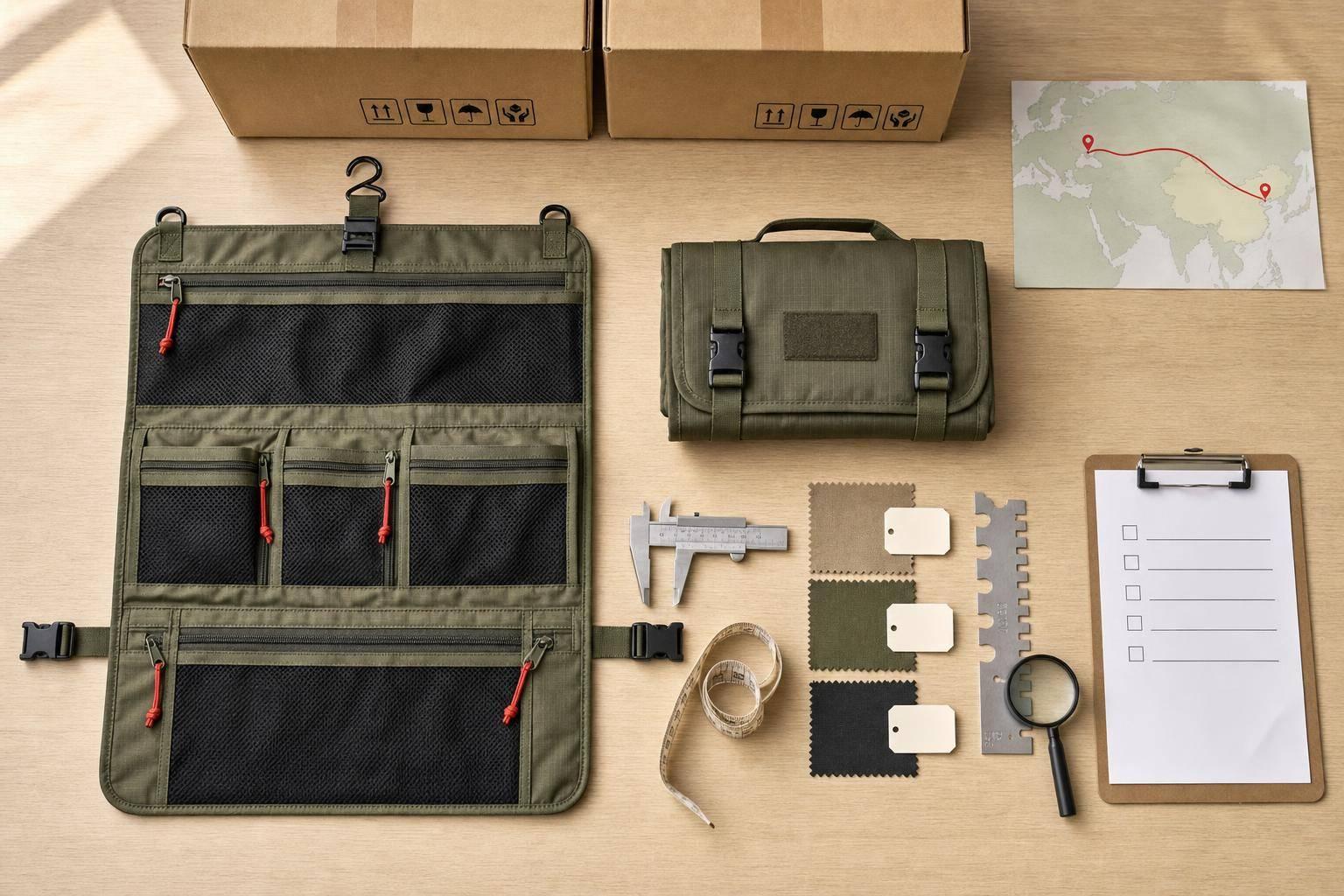
Put the open size, folded size, and load capacity on every spec sheet. A standard mid-size organiser opens to about 60 × 49 × 88 cm and folds to 61 × 15 × 53,5 cm.
Before you approve bulk production, test the folding action. That sounds simple, but it matters. If folding feels stiff or uneven in samples, that problem usually gets worse at scale.
"Six on-site checks - frame fit, screw alignment, folding action, load, wobble, finish - to catch defects before shipment." - Rolen Okina, Business Development, NINGBO YUFEI
Also check hardware alignment. Screws or rivets that sit out of line can weaken the joints over time, especially when the unit is folded and unfolded again and again in outdoor use. Add these checks to your pre-shipment inspection.
Once the spec sheet is final, packaging becomes the next big cost factor.
Compare Material Options and Packaging Formats
| Material Component | Common Specification | Key Benefit |
|---|---|---|
| Fabric | 600D Oxford cloth | High abrasion resistance and moderate water resistance at a low price point |
| Frame | Aluminium alloy tube | Lightweight for transport and corrosion-resistant outdoors |
| Shelving/Panels | Density board | Rigid surface for stacking items or food prep |
| Hardware | Steel screws/rivets | Essential for joint strength; requires alignment checks |
For retail orders, ask whether the pack is 1 unit per carton. Confirm carton size and gross weight on the sample. One quotation may show about 61 × 15 × 53,5 cm and 6,5 kg; measure the sample before you use it for courier or pallet planning to your distribution centre.
For wholesale orders, use master cartons with printed marks, labels, and barcodes. If you plan to include a bilingual manual in English and the destination language, or a private-label insert, approve the artwork and manual text before production starts, not during pre-shipment inspection.
It also helps to check 40HQ fill estimates early so you can map freight cost with fewer surprises. Small packing decisions can change carton count, pallet layout, and shipment planning more than many buyers expect.
Plan Cartons, Labels, and Shipping Method Early
Once the packaging is set, freight planning becomes the next big step. It often makes the difference between stock arriving on time or missing the season.
Set carton dimensions, weights, and label details before production wraps up. Approve carton marks, SKU references, country of origin, and local-language manuals before cartons are sealed. That way, what leaves the factory is exactly what you expect to receive.
It also helps to line up production and transit dates with the spring-summer sales window. If timing slips here, even a good product can land too late to sell well.
Use Mixed-Container Planning and Pre-Shipment Controls
For smaller or mixed orders, LCL (Less than Container Load) can make sense, especially when you're testing SKUs. The trade-off is more handling along the way, which can mean a higher risk of damage. For repeat items in larger volumes, FCL (Full Container Load) usually brings the lowest unit cost. Container load plans should be checked before freight is booked so unit counts are clear from the start.
The right setup comes down to the job at hand. If you're trialling one SKU, LCL may be enough. If you're shipping a full seasonal range, a different plan will usually work better.
| Shipping Method | Best Use | Cost Per Unit |
|---|---|---|
| LCL | Small batches / SKU testing | Higher |
| FCL | Large volume / repeat items | Lowest |
| Mixed-Container | Multi-SKU seasonal orders | Best unit cost for large repeat orders |
Mixed containers are a smart option when several outdoor SKUs are going out in one seasonal order. This matters most when one supplier is producing multiple outdoor SKUs for the same shipment. NINGBO YUFEI supports this setup directly, with mixed-container product planning, pre-shipment inspection, and container loading support for B2B buyers sourcing outdoor assortments.
Ask for loading photos and the final carton count before sealing. It’s a simple check, but it can help cut disputes around missing cartons, damage, and late arrivals.
"A packaging photo is useful only when it proves the final carton, inner protection, manual, accessories and carton mark match the shipment the buyer will actually receive." - Rolen Okina, Business Development, Ningbo Yufei
Conclusion: The Checklist Buyers Should Confirm Before Ordering
Before placing the order, confirm the spec, MOQ, samples, packaging, and shipping plan against your sales season.
How do I verify a supplier is a real factory?
Before you place an order, get the supplier’s legitimacy confirmed in writing. Then look at how they handle day-to-day communication: response time, accuracy, and consistency. In many cases, those signals tell you more about reliability than price ever will.
It also helps to clarify the factory’s core capabilities early on. Every factory has its own strong points, and getting that clear from the start can save time, money, and hassle later. Suppliers such as NINGBO YUFEI may also support pre-shipment inspection and container loading, which can help protect product quality and order accuracy.
When should I choose generic or private-label orders?
Choose generic or private-label orders when you want to test new products with a low MOQ or build a flexible product line without the extra cost and lead time that come with deep custom development.
This works well for online retailers and wholesalers that need to control inventory budgets while using retail-ready packaging and manuals in the destination language. Confirm that language before you treat the goods as ready for sale.
What should I test before approving bulk production?
Before you approve bulk production, get these points confirmed in writing:
- Supplier legitimacy
- Product specifications
- MOQ
- Pricing
- Packaging
- Quality control
- Shipping requirements
For final release, set an AQL, complete all documentation, and inspect the order when production is 80–100% finished. Review the product details, packing, and labels before you decide to ship, rework, or hold the order.