
Buyer guide
Customs Classification for BBQ and Camping Gear
On this page
- Function first: cooking appliance, seat, table, or textile camping article
- How material and chapter notes affect code selection
- Retail sets and essential character rules
- BBQ grills under the iron or steel appliance heading
- Disposable BBQs and mixed retail packs
- When BBQ tools are classified separately from the grill
- Camping chairs classified as seating furniture
- Folding tables classified as furniture, not camping goods
- Hammocks under textile camping goods, with exceptions for framed sets
- What to collect before confirming CN and TARIC codes
- Document formatting for clearance at your destination
- Conclusion: classify by function, confirm by material, then check set packing
- How do I choose the right CN code?
- When is a BBQ tool set classified with the grill?
- Can a hammock with a stand be classed as furniture?
If I get the customs code wrong, I change duty, VAT, and final landed cost at my destination. For BBQ grills, BBQ tools, camping chairs, folding tables, and hammocks, I would first check what the item does, then what it is mainly made of, and then whether it is shipped alone or as one retail set. This is a briefing note for a Balkan or Eastern European buyer. Serbia, Hungary and the Czech Republic are markets with reviewed buyer evidence on this site. Romania can be the destination, as one Eastern European example. The code and the duty are confirmed with your broker for that destination.
Imports into an EU member state use the EU CN and TARIC system. Import VAT is charged at the destination's rate, which you confirm with your broker, including what value it applies to. One code choice can change the import cost in the currency you sell in and can lead customs to ask for extra duty if the declared code does not match the goods. This article does not give you a code to copy onto an invoice.
Here is the short version:
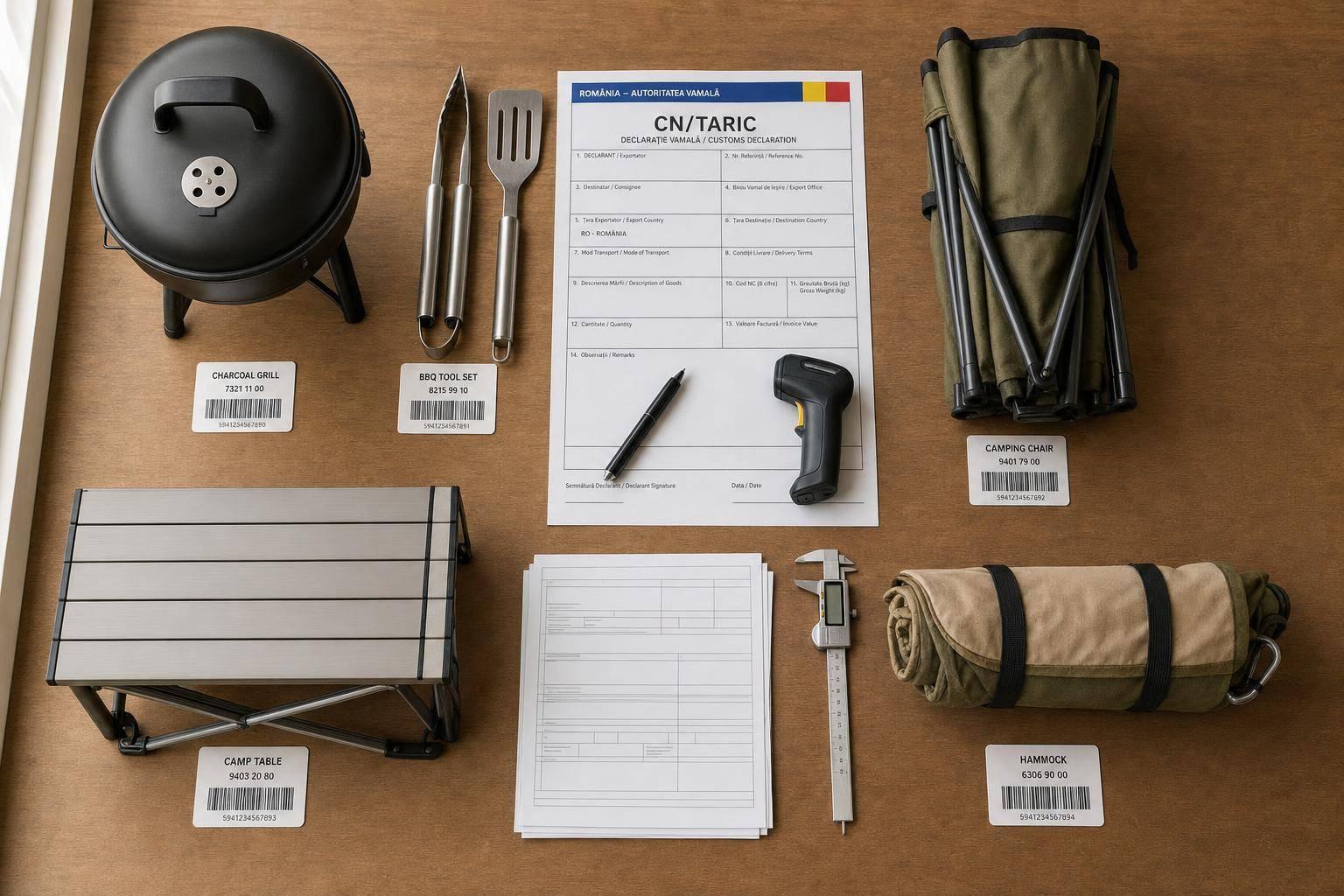
- BBQ grills usually go to Chapter 73, often heading 7321
- Loose BBQ tools can go under heading 8215
- Camping chairs usually go to heading 9401
- Folding tables usually go to heading 9403
- Textile hammocks usually go to heading 6306
- Retail packs follow the item that gives the set its main use under GRI 3(b)
What I would check before shipment:
- product function
- main material
- fuel type for grills
- bill of materials
- packing method
- photos, dimensions, and weight in cm and kg
A few shifts matter a lot. A charcoal grill and a single-use disposable barbecue set can land in different places under the same grill heading, and a hammock with a heavy stand may move away from textile camping goods and into a furniture heading. Ask the broker for the eight-digit code. The headings below are the questions to take to TARIC.
EU customs classification questions for BBQ and camping gear
| Product | Usual heading | Main check | What can change the result |
|---|---|---|---|
| BBQ grill | 7321 | fuel type + metal body | mixed-material build, retail set packing |
| BBQ tools | 8215 | separate utensil use | if packed with grill in one retail unit |
| Camping chair | 9401 | seating function | subheading changes by material |
| Folding table | 9403 | table function | subheading changes by main material |
| Hammock | 6306 | textile body | stand may move it to 9403 |
So the rule is simple: classify by use, confirm with material, then check how the goods are packed. That is the fastest way for me to cut code errors before pricing, quoting, or booking freight.
Outdoor gear often lands in Chapters 73, 94, or 63. The key point is simple: classification depends on function and construction, not the product name or where it's sold. The examples below show how that logic plays out in day-to-day customs work.
| Chapter | Typical products | Main material/function | Why the code changes |
|---|---|---|---|
| 73 | BBQ grills, fire bowls, steel stands | Iron or steel; cooking or heating function | Iron/steel cooking appliance |
| 94 | Camping chairs, folding tables, outdoor stools | Seating or table function; furniture | Furniture by function |
| 63 | Textile hammocks, fabric camping articles | Textile construction; rest article | Textile body defines the item |
Use this map to check each product line against function, material, and how the goods are packed.
Function first: cooking appliance, seat, table, or textile camping article
Start with function. That usually gives you the clearest answer.
A charcoal BBQ with a cooking grate and a stable frame is a cooking appliance. A folding chair with a seat surface and back support is seating furniture. A folding table meant to hold food or gear is a table. A textile hammock hung by ropes for lying down is a textile camping article.
EU customs look at the product's physical traits and normal use, not the wording used in marketing. Your member state's customs authority applies that test to the goods in the declaration.
How material and chapter notes affect code selection
Once you've pinned down the function, the material helps narrow the subheading.
Iron or steel construction on a BBQ grill points to Chapter 73. Camping chairs and folding tables, on the other hand, fall under Chapter 94 because function leads the analysis, not the frame material. So a metal-framed chair with a polyester seat is still furniture, since its main job is seating. Textile hammocks go to Chapter 63 because the fabric body supports the user and gives the item its character.
Chapter notes matter too, because they set boundaries. A stand-alone hammock stays in Chapter 63.
If goods are shipped together, though, set rules may override the code that would apply to each item on its own.
Retail sets and essential character rules
When products arrive packed as one retail unit, customs use the essential character rule under GRI 3(b). In plain terms, the set takes the heading of the part that gives it its main function.
A grill packed with tongs, a spatula, and a brush is still classified as a grill. The tools are accessories, while the grill is the item that drives the set. A folding table sold with matching stools is classified as furniture, with the code based on the part that gives the set its main function.
Before fixing the code, check the packing. That step can change the result.
This section narrows the general rules to grills, disposable sets, and loose tools. Complete BBQ grills go under the grill heading. Loose tools go under their own heading, unless they’re sold together as one retail set.
BBQ grills under the iron or steel appliance heading
Iron or steel BBQ grills are classified under heading 7321, which covers stoves, ranges, cookers, barbecues and similar non-electric domestic appliances of iron or steel.
From there, the fuel type decides the subheading:
- A gas-fuelled iron or steel grill is a gas-fuel question under heading 7321. Ask the broker for the subheading. Do not copy a six-digit example onto the invoice.
- A charcoal or wood-burning grill follows the solid-fuel branch under the same heading. The eight-digit CN code is what your broker confirms in TARIC for these goods.
Here’s the practical rule: if the firebox, frame, and grate are mainly iron or steel, heading 7321 is still the default, even when parts like handles or side shelves are plastic. But if the main body is aluminium, that heading may no longer fit, so the code needs to be checked again.
For mixed-material products or less usual designs, an EU importer can ask for a Binding Tariff Information (BTI) decision. BTI is a general EU route. Confirm with your broker whether it is worth requesting for this product and this member state.
Once a grill lands in 7321, the next step is simple: is the shipment one appliance, or is it a mixed retail pack?
Disposable BBQs and mixed retail packs
Take a single-use disposable barbecue sold as a retail pack with an aluminium tray, a steel wire grill and stand, charcoal briquettes, and firelighters. The question for the broker is which part gives the pack its character. This article does not assign that pack an eight-digit code.
The reason is straightforward. The barbecue assembly gives the pack its main character. The charcoal and firelighters are there to support that item, not define it.
The same logic applies to a charcoal grill sold in one carton with tongs, a spatula, and a grill brush. If the grill is the main part in terms of value and function, the whole set follows heading 7321. If those items come in separate cartons, they’re classified separately.
When BBQ tools are classified separately from the grill
Loose BBQ tools are classified on their own only when they are not part of the grill’s retail pack.
Tongs, spatulas, forks, skewers, and similar items sold separately are classified under heading 8215 as spoons, forks, ladles, tongs and kitchen or table articles of base metal. A stainless-steel BBQ tong set sold on its own is a question under heading 8215. Confirm the subheading in TARIC.
A grill cleaning brush works differently. It’s classified by its cleaning function, so it follows a brush heading instead of 8215.
This is where paperwork matters more than many importers expect. Clear invoice and packing-list descriptions help customs see whether the shipment is a grill appliance or a separate tool kit.
| Product | Key components | Likely code | Set-packing effect |
|---|---|---|---|
| Charcoal BBQ grill | Iron or steel body, cooking grate | Heading 7321, solid-fuel branch — confirm the digits in TARIC | Included tools may follow the grill code if sold as one retail set |
| Gas BBQ grill | Iron or steel body, gas burners | Heading 7321, gas-fuel branch — confirm the digits in TARIC | Classified as a complete cooking appliance |
| Disposable BBQ set | Aluminium tray, steel grill/stand, charcoal, firelighters | Heading 7321 — confirm the digits in TARIC | Treated as one barbecue unit; accessories follow the grill heading |
| Standalone BBQ tools | Tongs, spatulas, forks, skewers (base metal) | Heading 8215 — confirm the digits in TARIC | Classified separately unless packed with a grill as one retail set |
| Grill cleaning brush | Handle and wire brush head | Brush heading | Classified by cleaning function, not food-handling function |
After BBQ grills and tools, the next step is to check whether the item is seating, a table, or a textile article. If you get that wrong before booking shipment, you can end up with the wrong duty rate or delays at customs in your member state.
Camping chairs classified as seating furniture
A folding camping chair is classed as seating furniture. Heading 9401 covers seats of all kinds, including folding chairs, deck chairs, stools, and benches, as long as the product’s main job is to support a person in a sitting position.
So even if the chair folds up and is sold for camping, it still stays in 9401. The frame material and any upholstery don’t change the heading. They only narrow down the CN subheading.
Put simply: start with function first. Material comes after that.
Folding tables classified as furniture, not camping goods
A folding camping table falls under 9403 as furniture. It stays in 9403 even if the seller calls it a camping table or picnic table. Marketing labels don’t move it into 6306.
The subheading inside 9403 depends on the main material of the table’s structure:
- An aluminium-frame table is a metal-furniture question under 9403. Confirm the subheading in TARIC
- A wooden camping table is a wood-furniture question under 9403. Confirm the subheading in TARIC
- A plastic folding picnic table is a plastic-furniture question under 9403. Confirm the subheading in TARIC
Things can get trickier when the table has a metal frame but a wood or plastic top. In that case, customs apply GRI 3(b) and look at the material that gives the table its essential character. GRI 3(b) is general EU classification practice. The resulting digits still have to be confirmed for the goods. That’s why it helps to ask for a bill of materials before shipment, with weight or value shares clearly shown.
Hammocks under textile camping goods, with exceptions for framed sets
The same essential-character rule used for BBQ retail packs also applies to hammock sets.
A standalone textile hammock is a question under heading 6306. Confirm the subheading in TARIC. But once a hammock is sold together with a stand, the result can change. A hammock with a heavy fixed stand may move to 9403 if the stand gives the set its essential character.
| Product type | Main materials | Likely heading direction | Why the result may shift |
|---|---|---|---|
| Folding camping chair | Metal or wooden frame, textile seat | 9401 (Seats) | Frame material and upholstery change the specific subheading. |
| Camping stool or bench | Metal, wood, or plastic frame | 9401 (Seats) | If the product doubles as storage, an essential-character review may move it out of 9401. |
| Folding camping table | Aluminium, steel, wood, or plastic | 9403 (Other furniture) | Principal material determines the subheading; outdoor use alone does not move it to 6306. |
| Textile hammock (no stand) | Woven fabric, ropes | 6306 (Camping goods) | Rigid or non-textile components dominating the product can shift it toward furniture headings. |
| Hammock set with stand | Textile hammock + metal or wood stand | 6306 or 9403 | A heavy, fixed stand may give the set its essential character, moving it to 9403. |
Before you confirm the code, ask the supplier for the frame material, upholstery details, and packing details. That small check can save a lot of back-and-forth later.
Once function, material, and packing determine the code, lock those details into the supplier file before booking the shipment.
What to collect before confirming CN and TARIC codes
Before you book a shipment, gather the product data customs will check. For BBQ and camping goods, that usually includes a detailed bill of materials, exact dimensions and weight in metric units, frame type, textile composition, fuel type for grills, high-resolution product photos, and the packing method - whether the goods ship as single units or as retail sets.
Document each SKU with the exact material split, dimensions, weight, and packing form.
| Data point | Specific detail needed | Why it matters for classification |
|---|---|---|
| Material composition | Textile denier, metal type (aluminium/steel) | Determines the CN chapter, such as Chapter 63 or 94 |
| Dimensions and weight | Product size and G.W./N.W. in cm and kg | Needed for the declaration and for a landed-cost estimate in your selling currency |
| Fuel type | Charcoal, gas, or electric | Needed to confirm the declared grill specification |
| Packing method | Single item vs. retail set | Needed to confirm set treatment in the paperwork |
| Product-specific test reports and declarations | Test reports and conformity documents | Supports clearance and import control |
Ask NINGBO YUFEI, or the factory, which specs, packing details, manuals, and inspection records this order can include for the grills, chairs, tables, or hammocks you selected. What is actually supplied is confirmed for the order.
Document formatting for clearance at your destination
Use metric units and °C throughout. Use the date and number format your destination's invoices already use. Prepare manuals and carton marks in the language that destination requires, once you have confirmed it. Also make sure the packing lists, carton labels, and the physical goods match before pre-shipment inspection.
When the supplier file is complete, customs review is usually faster and more consistent.
Conclusion: classify by function, confirm by material, then check set packing
Start with function, confirm material, then check packing. Those three steps are how you brief the broker. They do not replace the code the broker confirms for your destination.
How do I choose the right CN code?
To brief the CN code for an EU import, look at the product’s main use, material, and overall make-up. For BBQ grills, camping chairs, and folding furniture, the code can change based on how customs sees the item: as furniture, a household appliance, or a portable tool. Romania can be the member state of import. It is one example.
If the goods come in as a set, classification usually follows the part that gives the set its essential character. That’s why clear technical paperwork matters. Ask NINGBO YUFEI, or the factory, for the product specs and carton data this declaration needs, and confirm that the file matches the goods being shipped.
When is a BBQ tool set classified with the grill?
A BBQ tool set is usually classified with the grill when both are packaged together as a functional unit for retail sale, like a starter kit.
When the tools are sold on their own, they’re classified based on what they’re made of and what they do.
Can a hammock with a stand be classed as furniture?
Yes. A hammock with a stand can be classed as furniture for customs purposes.
A hammock on its own is often put in a separate product group. But once you add a fixed stand, the item changes in practical terms. It becomes a piece used for seating or resting, which pushes it toward the furniture category.
For an import into your member state, your paperwork should show this functional change clearly so customs can apply the duty treatment your broker has confirmed.