
Buyer guide
EN 581 Record Guide for EU Outdoor Buyers
On this page
- Match product type and use environment
- Verify adult-use scope and tested configuration
- Record the exact model identity
- Required EN 581 test reports and what they must include
- Supporting factory documents linked to the tested model
- Where NINGBO YUFEI support fits into record collection
- Check model codes, dimensions, materials, and mechanisms
- Review EN 581-related safety points during inspection
- Use this comparison table
- What to store in the technical file
- How to check records before resale or repeat orders
- Conclusion: The EN 581 record checks buyers must not skip
- Do I need all EN 581 parts for every SKU?
- When does a product change require retesting?
- What happens if one shipment record is missing?
If I import outdoor furniture into the EU, I need 4 checks in place before shipment: scope, reports, shipment match, and file storage. If one record is missing, goods can be held, checked again, or pulled into a file review by market surveillance.
Here’s the short version:
- I match each SKU to the right EN 581 part
- I confirm the right use class: camping, domestic, or contract
- I collect the lab report, factory checks, manuals, labels, and packing proof
- I make sure the shipped product is the same as the tested sample
- I store one buyer file per SKU, dated in 24.08.2026 format
EN 581 is split into 3 parts:
| Part | Covers | What I check first |
|---|---|---|
| EN 581-1 | General safety for outdoor seating and tables | Scope, adult use, safety points |
| EN 581-2 | Mechanical safety for outdoor seating | Chairs, stools, stability, loads |
| EN 581-3 | Mechanical safety for outdoor tables | Tables, strength, stability |
A few points matter most:
- 1 wrong model code can break the link between shipment and test report
- 3 use classes change the test route
- 1 folder per SKU keeps the file ready for EU checks
- Even small changes in frame, fabric, joint, lock, or manual can mean the old report no longer fits
In simple terms: I do not approve loading until the product, paperwork, and carton marks all match. That is the core idea behind the full guide.
EN 581 EU Import Compliance: 4-Step Record Checklist
Start with the EN 581 part from the table above. Use it as the first filter for every SKU. Before any testing is booked, map each SKU to one EN 581 part and one use category. Use the part number from the table above, then check that it matches the SKU’s declared use and the configuration that was tested.
Match product type and use environment
Then confirm the use environment. EN 581 recognises three categories - camping, domestic, and contract - and each one has different load and durability requirements. A folding camping chair and a garden chair are both seating, but they do not follow the same test path. Furniture meant for restaurant terraces or public spaces must go through the contract-use route. That scope call decides which report the factory and the lab need to issue.
The SKU’s use category becomes the label on the test record and links straight to the buyer file.
EN 581-1 covers outdoor seating and tables for general safety points such as sharp edges and tubular ends. Confirm the intended use environment before booking any testing.
Verify adult-use scope and tested configuration
EN 581 applies to adult outdoor furniture only. If any SKU in the container is marketed or designed for children, it sits outside EN 581 scope and needs a different standard.
Then check the tested setup against the shipped version. The tested position, mechanism state, and adjustment range must match what is being sold. A report for a fixed-back chair does not also cover that same SKU if it is sold with a reclining backrest. If the tested state and shipped state do not match, the file breaks. The report no longer covers the product the buyer is putting on the market.
Record the exact model identity
For each SKU, make a simple line-item record. Include the model code, dimensions in millimetres, frame material, fabric or surface finish, and any mechanical features such as folding or reclining. This record links inspection findings to the final EN 581 report.
| Identification Detail | What to Record | Why It Matters |
|---|---|---|
| Model code | Factory SKU or item reference | Links product to test report |
| Dimensions | Length × width × height in mm | Confirms physical match to tested sample |
| Materials | Frame type, fabric type, finish | Checks material scope in the report |
| Mechanisms | Folding, reclining, height-adjustable | Checks that the safety test covers the actual function |
| Use category | Camping, domestic, or contract | Sets the right test route under EN 581 |
Record the exact model identity before shipment so the SKU can be linked to its report. Use that record as the reference line when matching shipment documents to the test report.
Use the SKU record from Checklist 1 to ask for the matching reports and factory documents.
Required EN 581 test reports and what they must include
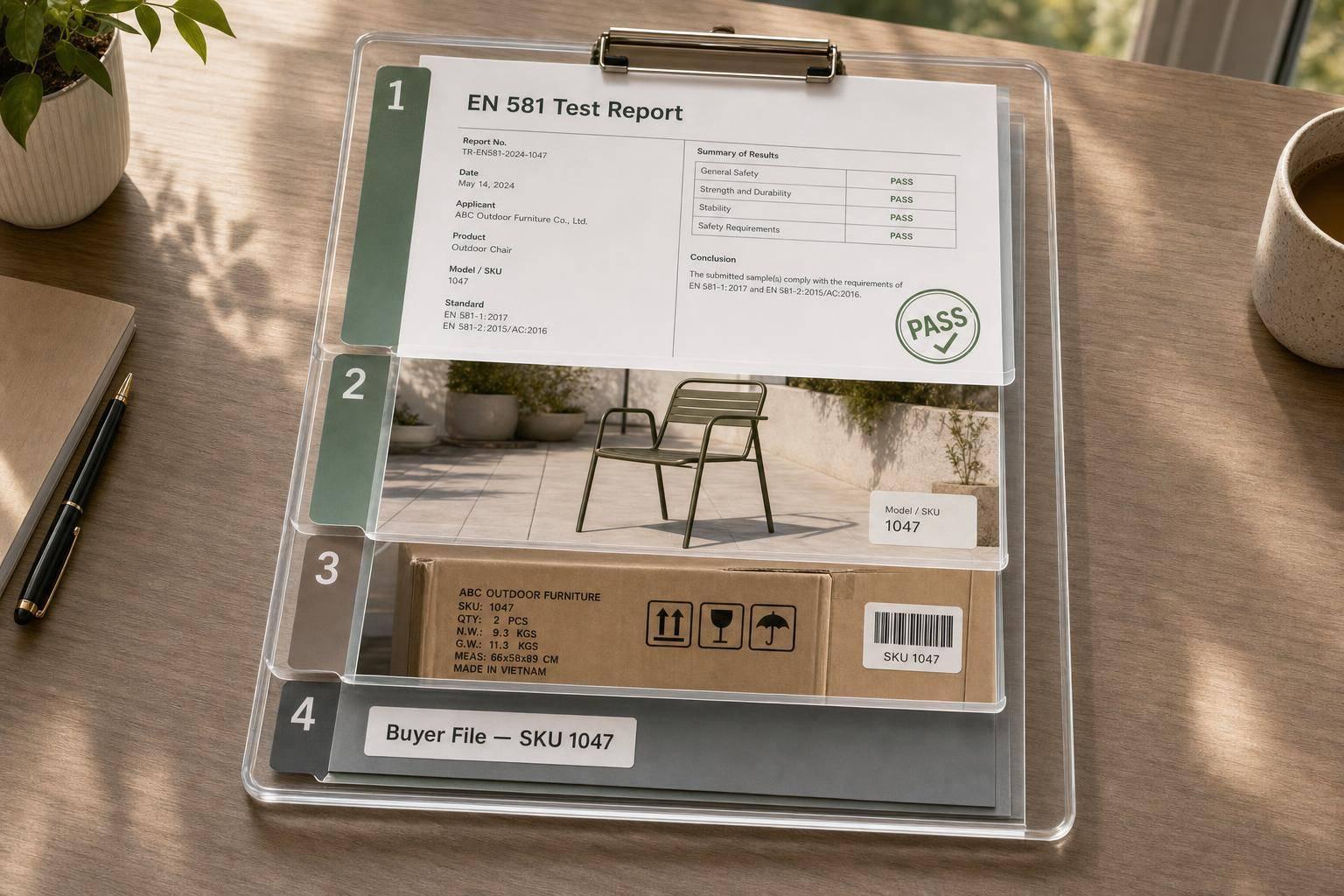
Request the right reports for EN 581-1, EN 581-2, and EN 581-3, based on the product type. A full report should include:
- the standard edition used
- the tested model name
- product dimensions in millimetres
- test results by clause
- an overall pass/fail result
- lab identification details
- photographic annexes of the tested sample
Use each report to check that the tested sample matches the SKU record from Checklist 1. If even one core item is missing, the report is incomplete.
Supporting factory documents linked to the tested model
Alongside the lab report, ask for these documents before final payment or shipment release:
- Mass-production inspection report
- Container loading inspection report
- Packing photos: final outer carton with inner protection, packed product with manual and accessories, and carton mark
The carton marks must match the packing list.
Ask for manuals and labels in the language your destination requires. Romanian is the example when Romania is the destination. Serbia, Hungary and the Czech Republic are other destinations with reviewed buyer evidence on this site, and each one needs its own language check.
Packing photos should clearly show the final carton, inner protection, manual, accessories, and carton mark. On site, check the final manuals and carton contents before shipment release.
Where NINGBO YUFEI support fits into record collection
For mixed-SKU orders, keep all records in one shipment file. Ask NINGBO YUFEI, or the factory, which of these the order file will include: sample checks, manuals in the destination language, packaging records, a pre-shipment inspection, and a container-loading record. What is included is confirmed for the shipment.
Next, match each shipped model to its EN 581 report before release.
Before loading starts, compare the tested sample with the goods in the shipment. The carton mark, packed contents, and product setup must match the approved EN 581 record. Use the records from Checklist 2 as your control set for this check.
Check model codes, dimensions, materials, and mechanisms
Start with the model code. The identifier printed on the carton must match the model name or SKU in the EN 581 report exactly. No shortcuts here. If one letter, number, or suffix is off, treat it as a mismatch.
Then move to the physical details. Check dimensions, frame details, materials, load rating, and mechanisms against the tested sample and the EN 581 report. A chair may look almost the same at first glance, but “almost” doesn’t count. If the mechanism or assembly is different from the tested sample, that report does not cover the SKU.
Also compare the shipment with the factory specification sheet and the lab report to spot any material substitution. A different tube thickness, fabric, fastening method, or joint style can put the whole match in doubt.
Review EN 581-related safety points during inspection
During pre-shipment inspection, check the points tied to safety and stability. That includes frame construction, leg geometry, folded dimensions, load rating, and any pinch points on moving parts in inspection. These are the details that can change how the product performs in use.
You should also confirm that the packed product, manuals, and accessories still match the approved sample. A missing warning label or a swapped accessory might seem minor, but it can mean the packed unit no longer lines up with the approved record.
If the inspected goods differ from the tested configuration in any safety-critical detail, hold the shipment until the discrepancy is resolved.
Use this comparison table
Complete one row per SKU before approving loading.
| Check point | What to compare | Pass condition |
|---|---|---|
| Model code | Lab report vs. carton mark | Exact alphanumeric match |
| Dimensions | Factory spec vs. inspection sample | Matches tested configuration |
| Frame and joints | Material type and joint style vs. sample | Matches tested configuration |
| Locks and moving parts | Mechanism type vs. physical test | Functions match report |
| Fabric and attachment points | Textile weight and attachment points vs. sample | Matches tested configuration |
| Manuals and labels | Report vs. packed product | Correct warnings present |
| Packaging | Packing photos vs. final shipment | Carton, inner protection, manual, accessories, and carton mark match the approved sample |
If any row fails, do not approve loading until the issue is corrected. Record the pass/fail result in the buyer file before shipment approval.
Once the model-to-report match passes, use that same record as the buyer-file reference for shipment approval.
Once the shipment matches the tested model, put the proof in one place. After the model-to-report comparison table passes, archive everything in a single model-level buyer file. Keep that file ready in case the destination's market-surveillance authority, or another EU authority, asks to review it after the product goes on sale. Confirm which authority applies to your member state.
What to store in the technical file
Keep records at the model level. In plain terms, that means one folder per SKU. Use the same naming format across all files, and save every document with the date format 24.08.2026.
The folder should include the records below. Each one helps prove that the shipped product is the same as the tested sample, and that production stayed in line with the approved model.
| Document category | Specific items | Purpose |
|---|---|---|
| Compliance records | EN 581 test reports (Parts 1, 2, 3 as applicable) | Prove safety and durability standards are met |
| Product identity | Product specs, model codes, dimensions, materials, labels, assembly manuals, accessory lists | Confirm the shipped item matches the tested sample |
| Quality evidence | Mass production inspection reports, loading inspection reports | Prove production stayed within spec |
| Traceability | Packing list, invoice, shipment references, carton marks | Link specific shipments to the technical file |
| Visual proof | Photos of the final outer carton, inner protection, packed product with manual and accessories, and carton mark | Link the shipped unit to the approved sample |
Store photos of:
- the final carton
- inner protection
- the packed product
- the manual
- accessories
- the carton mark
Use this same folder later to check future orders against the tested SKU. That saves time, but more than that, it keeps the paper trail clean.
How to check records before resale or repeat orders
The buyer file is not just for the current shipment. It also acts as the control point for repeat orders.
Before you approve a reorder, check three things:
- the EN 581 report edition is still acceptable
- no design, material, or component changes have been made since the last tested batch
- no design, size, colourway, material, manual, or label change has been added outside the scope of the existing file
If anything changed, retesting is required before the order ships. That’s the line in the sand.
It also helps to include quality requirements and EN 581 acceptance criteria directly in the purchase contract. That gives you a clear reference point when it’s time to verify the goods.
Conclusion: The EN 581 record checks buyers must not skip
When these four checks pass, the buyer file stays audit-ready and ready to use again for repeat orders.
Do I need all EN 581 parts for every SKU?
No. You only need the EN 581 mechanical safety parts and tests that apply to that specific outdoor furniture type and its risk points.
Before shipment, check that the factory’s test reports match the exact model and carton configuration, and that all required parts are included.
When does a product change require retesting?
For outdoor furniture sold in EU markets under EN 581, retesting is required when there is a major change to the product’s design, materials, or manufacturing process that could affect mechanical safety or compliance.
Importers should make sure the test reports they keep on file match the exact specifications of the current production batch.
What happens if one shipment record is missing?
If even one shipment record is missing, your quality control and compliance process starts to fall apart. You no longer have the full paper trail needed to confirm that the product matches approved standards. And once that gap appears, the risk doesn’t stay in one place, it can spread across the entire supply chain.
That can trigger customer service problems, formal claims, and product returns when the goods don’t match verified specifications. NINGBO YUFEI recommends pre-shipment inspection as the final checkpoint to decide whether a shipment should be released, reworked, or put on hold.