
Buyer guide
EUDR Matters: What Outdoor Furniture Buyers Must Ask Before December 30, 2026
On this page
- Start with the exact product and material construction
- Ask for plot-level geolocation data
- Confirm the harvest date or production period
- Request legality evidence for each wood component
- Treat FSC and PEFC as supporting evidence, not a replacement
- Confirm who files the Due Diligence Statement
- Check the documents before booking the shipment
- Use this supplier checklist
- Product and classification
- Source and location
- Legality and supporting documents
- DDS and timing
- Start with a rough product list
If you import wooden outdoor furniture or garden products into the European Union, the next important question is not only “What is the product price?”
You also need to ask:
- What wood is used in each product?
- Where was that wood harvested?
- Can the supplier provide plot-level location data?
- Who will submit the Due Diligence Statement?
- Will the required information be ready before shipment and customs clearance?
The EU Deforestation Regulation, or EUDR, applies to relevant products placed on the EU market. For large and medium-sized operators, the main application date is 30 December 2026. Micro and small operators generally have until 30 June 2027, although micro and small businesses already covered by the EU Timber Regulation may also face the 30 December 2026 date. Check your company status and product position with your customs or compliance adviser.
This article is a practical sourcing guide, not legal advice. It explains the questions we recommend asking when building an outdoor living wholesale range from China.
Start with the exact product and material construction
A product name such as “wooden garden table” is not enough for EUDR preparation.
Ask your outdoor products supplier for a clear material breakdown for every selected SKU:
- Tabletop material
- Frame material
- Legs and support parts
- Wooden hardware or decorative parts
- Bamboo, rattan, plywood, MDF or engineered wood components
- Packaging components, where relevant
- Any recycled or reclaimed material claims
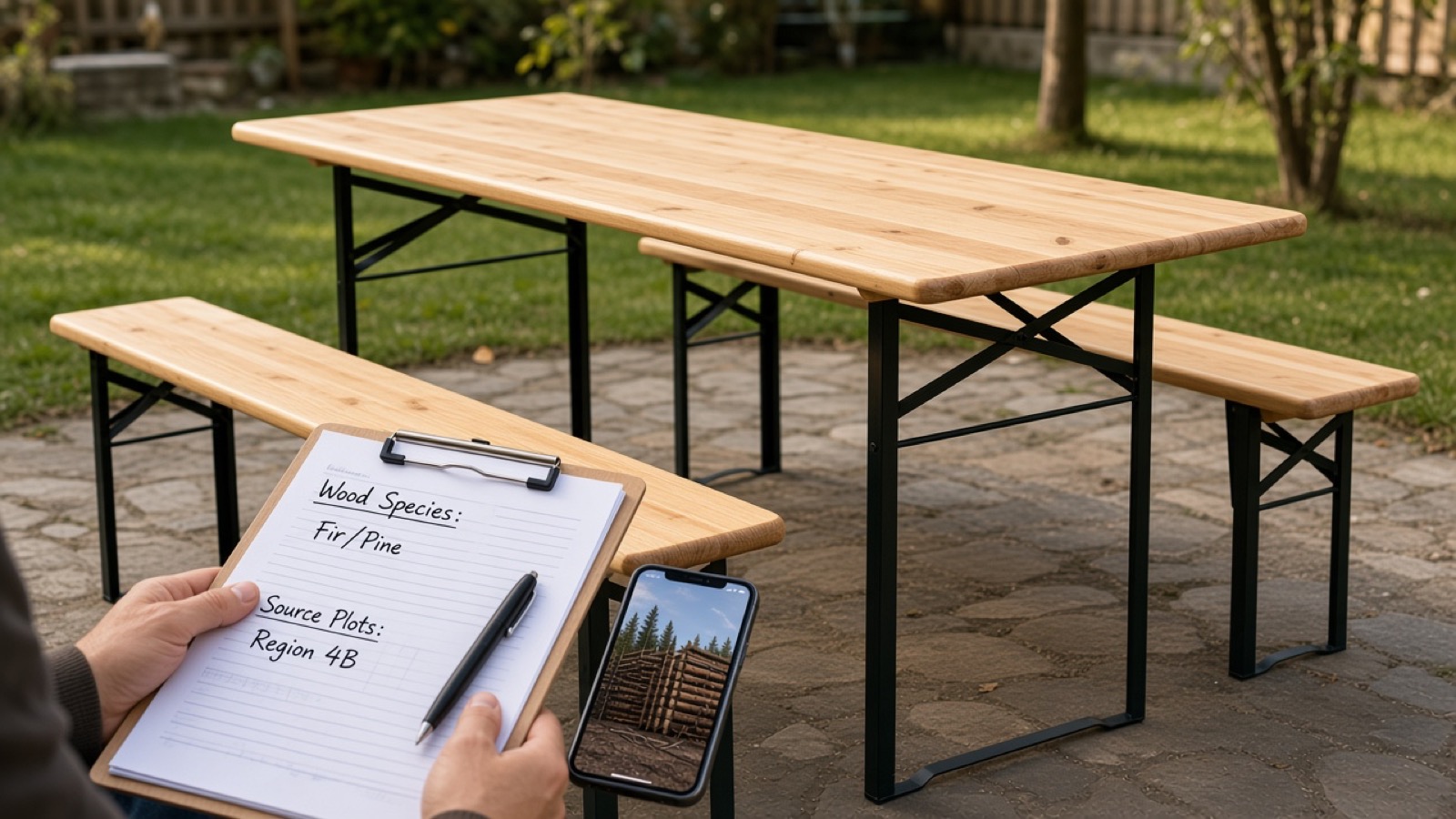
A product can contain more than one type of wood. A garden chair may use one species for the frame, another material for the seat, and plywood for a small support panel. Each relevant wood component needs to be connected to the correct source information.
Also ask for the product’s likely CN code and, where applicable, the import classification used in TARIC. If you import into another market, your customs adviser may refer to an HTS or other tariff code. Do not rely only on a supplier’s marketing description.
The EUDR scope is connected to the product classification listed in Annex I of the Regulation. Some wooden furniture and furniture parts are covered, but the exact classification must be checked against the finished product and its construction.
Use the EUDR legal text and Annex I as the starting reference. For a binding tariff decision, speak with your customs broker or competent authority.

Ask for plot-level geolocation data
The factory address is not the same as the wood’s production location.
For each relevant wood component, ask your supplier to provide the location of every plot where the wood was produced or harvested. The information should include:
- Country of production
- Relevant region or subnational area
- Latitude and longitude
- The plot connected to the specific wood component
- The date or time range of production or harvesting
If wood from several plots is used in one product, all relevant plots need to be included. A general statement such as “wood from China” or “wood from a certified source” does not replace plot-level information.
For wood plots larger than four hectares, the EUDR requires polygon data that describes the plot perimeter. A single central point is not sufficient for these larger plots. For smaller plots, the required format may be different, but the data still needs to identify the relevant production area accurately.
Ask your supplier this direct question:
Can you provide the geolocation data for every plot connected to each relevant wood component, including polygons for plots over four hectares?
If the answer is unclear, do not wait until the container is ready to load. Traceability information can take time to collect and review.
The European Commission’s due diligence guidance explains the information operators must collect, including geolocation and production dates.
Confirm the harvest date or production period
EUDR information is linked to the plot and the relevant commodity, not only to the finished furniture.
Ask for the harvest date or an appropriate production period for each source plot. Depending on the available records, this may be an exact date, harvesting season or other permitted time range.
The important point is that the date should be connected to the wood source. A factory production date, purchase order date or container loading date is not automatically the harvest date.
For example, the following records may need to be kept separate:
- Wood harvested from a plot in a specific season
- Wood processed by a sawmill later
- Furniture manufactured at a factory months afterward
- Finished goods shipped to the EU on a later date
This chain should be understandable from the supporting documents. If the supplier cannot connect the harvest period to the source plot and the relevant wood component, ask what additional evidence is available.
Request legality evidence for each wood component
EUDR is not limited to deforestation-free status. The wood must also have been produced legally under the laws of the country of production.
Ask your supplier what documents support the legal origin of each wood component. Depending on the source country and supply chain, useful evidence may include:
- Harvesting or forest-use permits
- Land-use or land-tenure documents
- Concession or management records
- Official authority records
- Contracts or community-use documents, where relevant
- Supplier invoices and chain-of-custody records
- Audit or verification records
- Evidence related to local harvesting and environmental requirements
The documents should be connected to the actual wood used in the product. A document for one wood supplier should not automatically be treated as evidence for every product or every factory.
This is one reason mixed-container sourcing requires careful product-level coordination. Several SKUs may come from different factories, while different factories may use different wood suppliers. The documentation needs to follow the actual construction and supply chain.
Treat FSC and PEFC as supporting evidence, not a replacement
FSC or PEFC certification may help demonstrate responsible sourcing and can be useful as complementary information.
However, certification does not automatically replace the EUDR due diligence process. You still need to establish whether the product is in scope, collect the required product and source information, assess risk and complete the relevant declaration process.
Ask your supplier for:
- Certificate number
- Certificate scope
- Certified company name
- Validity dates
- Products or materials covered
- Chain-of-custody information
- The link between the certificate and your selected SKU
Then keep in mind what the certificate does and does not demonstrate. It may support your review, but it may not provide every EUDR data point, such as the full set of plot coordinates and production dates.
The European Commission explains that certification and third-party schemes may provide complementary information, but operators remain responsible for their own due diligence.
Confirm who files the Due Diligence Statement
The Due Diligence Statement, or DDS, is submitted through the EUDR Information System before the relevant product is placed on the EU market or the import customs declaration is lodged.
In a standard import transaction, the EU importer or other responsible operator usually needs to determine its role and complete the required process. An authorised representative may submit the statement on behalf of an operator, but the operator remains responsible for compliance.
Do not assume that your China supplier automatically files the DDS for you.
Ask these questions before agreeing the order:
- Which legal entity is the EUDR operator for this shipment?
- Who will register and submit the DDS?
- Who will provide the DDS reference number to customs or the relevant buyer?
- Which supplier documents will support the statement?
- What happens if a wood component changes after the statement is submitted?
- How long will the supporting records be retained?
The European Commission’s roles and responsibilities guidance explains that the operator placing a relevant product on the market is responsible for carrying out due diligence and submitting the DDS.
The importer should confirm its exact legal position with its customs adviser or Member State competent authority.
Check the documents before booking the shipment
For an outdoor living wholesale order, document review should not happen only after production is complete.
Before booking the shipment, compare the following:
- Final product specification
- Product photographs or approved samples
- SKU and model numbers
- Carton markings
- Packing list
- Wood species and material construction
- Source plot information
- Harvest date or production period
- Legality evidence
- Certification records
- CN or TARIC classification
- Quantity and shipment details
This is also where mixed-container sourcing needs discipline. A single container may include picnic tables, garden chairs, storage products, gazebos or other outdoor items. The products may have different suppliers, materials and documentation requirements.
Our role as a mixed-container sourcing partner is to help align the selected products, cartons and shipment plan before cargo release. For wooden products, that means confirming the available wood documentation by component before booking wherever possible.
These checks do not replace your legal due diligence or customs responsibility. They provide a practical bridge between product selection and the information your compliance process may require.
Use this supplier checklist
You can send the following checklist to your supplier or sourcing partner:
Product and classification
- Confirm the exact product name and SKU.
- List every wood or wood-based component.
- State the wood species using common and scientific names where available.
- Provide the proposed CN or TARIC classification.
- Confirm whether any material is recycled or reclaimed.
Source and location
- Identify the country and region of production.
- Provide the geolocation of every relevant source plot.
- Provide polygon data for plots over four hectares.
- Link each plot to the relevant wood component or product.
- Provide the harvest date or permitted production period.
Legality and supporting documents
- Provide evidence of legal harvesting and land use.
- Provide supplier and chain-of-custody records.
- Share FSC or PEFC information if available.
- Confirm which documents relate to the actual selected SKU.
DDS and timing
- Confirm who will act as the EUDR operator.
- Confirm who will submit the DDS.
- Confirm when the DDS reference number will be available.
- Confirm that all required information can be reviewed before shipment.
- Explain how changes to materials or suppliers will be reported.
Keep the checklist product-specific. A general company statement is useful for orientation, but it does not confirm the details of an individual shipment.
Start with a rough product list
You do not need a perfect buying plan to begin.
Send your outdoor furniture links, catalogue pages, product photos or a rough list. Include your destination market, sales channel and approximate quantities if you have them.
We can then help separate:
- Products that may require closer EUDR review
- Items with unclear material construction
- SKUs needing supplier documentation
- Carton and mixed-container questions
- Details that must be confirmed before booking
You can start with a rough product plan or send your sourcing brief. A partial list is enough for the first conversation.
For official information, review the European Commission EUDR page, the due diligence guidance, and your Member State competent authority.
The practical goal is simple: identify the relevant wood, connect it to the correct source information, confirm who handles the DDS, and complete the documentation review before the container is released.
Start with the closest product list you have.