
Buyer guide
Top 6 Tests During Outdoor Furniture Inspection
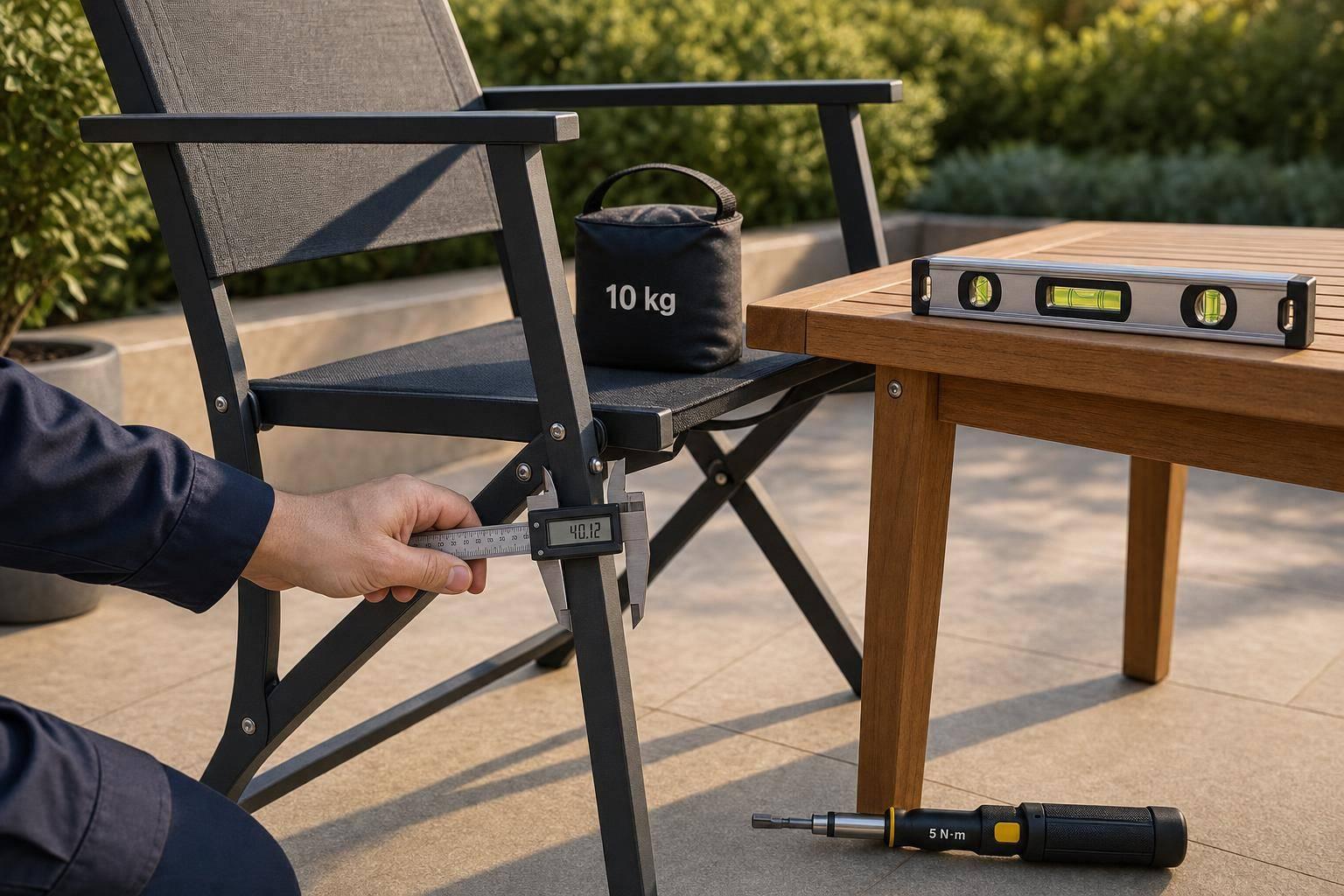
If I want to stop returns before shipment, I focus on six checks: frame fit, screw hole match, folding action, weight bearing, wobble, and finish.
That is the core message of this article. I’d run these tests before container loading, when at least 80% of cartons are packed but still available for inspection. The reason is simple: a chair or table can look fine in photos and still fail during assembly, under load, or after a few uses outdoors.
Here’s the short version of what matters most:
- Frame fit checks whether parts line up and assemble without force
- Screw hole match checks whether screws enter cleanly and holes are not offset
- Folding action checks whether hinges and locks work through 5–10 cycles, or up to 20 cycles for higher-risk items
- Weight bearing checks whether the unit holds the agreed load, such as 160 kg for a domestic chair for 1 hour
- Wobble checks whether the item stays level, with leg lift kept to about 1–3 mm
- Finish checks paint, powder coating, welds, rub-off, and coating thickness, often around 80–120 µm
If I had to sum it up in one line, it would be this: test function first, looks second.
These checks are built for factory-floor use with simple tools, photos, videos, a ruler, a spirit level, and a clear checklist. They also fit normal PSI work, with AQL 2,5 for major defects, AQL 4,0 for minor defects, and AQL 0 for critical safety issues.
6 Outdoor Furniture Inspection Tests: Pass Criteria & Risk Guide
| Test | What I check | Simple pass point | Main risk if missed |
|---|---|---|---|
| Frame fit | Parts, shape, assembly | No forced fit, no distortion | Assembly complaints, loose frame |
| Screw hole match | Hole alignment, screw entry | Screws enter without force | Buyer cannot assemble unit |
| Folding action | Hinges, locks, movement | Opens/closes smoothly, lock holds | Collapse, pinching, returns |
| Weight bearing | Load strength | No bending, cracks, or sag after load | Safety claims, warranty cases |
| Wobble | Level and stability | Little or no rocking on flat surface | Poor user feel, bad reviews |
| Finish | Coating and weld quality | No rust, bare spots, sharp welds | Corrosion, damage, complaints |
For me, the article’s main point is clear: these six tests help decide one thing fast - release, rework, or hold the batch.
These tests focus on the failure points that show up most often: frame fit, screw alignment, folding action, load capacity, wobble, and coating quality. The best way to run them is in this order: fit, assembly, movement, load, stability, finish.
Use the same checks for garden chairs, tables, loungers, camping sets, swing chairs, and modular seating made from metal or mixed materials.
The goal is to test function and durability, not looks alone. A product can seem fine in photos and still fail during assembly, under weight, or after a short period of outdoor use. Buyers in this region often want seasonal furniture that can come back out for more than one season. Confirm that expectation with your own customers. The inspection checks function. It is not a durability promise.
You don’t need a laboratory for any of this. Frame fit, screw hole matching, folding action, weight bearing, wobble, and finish review can all be done on the factory floor with basic tools and a clear checklist. That kind of simple check helps spot defects before loading and can cut claims after arrival.
The next section breaks these risks into six quick on-site tests.
Start with fit. If the frame is off, every test that comes after becomes less dependable.
Open one sample and check each frame part against the BOM and drawing. Look for bends, warping, or missing parts. Then assemble the unit exactly as instructed, using the supplied tools. The parts should go together without hammering, extra force, or enlarging holes. All locks should seat fully. If any part needs bending, forcing, or hole enlargement to fit, the sample fails this test.
After assembly, place the unit on a flat, rigid surface. Check that the frame is square, symmetric, and level. Pass criteria usually include:
- leg height variance within 2,0 mm
- joint gaps within 1,0–1,5 mm
- diagonal differences within a few millimetres
- wobble under 5 mm
Fail any unit that needs force during assembly or shows visible distortion after assembly. Common defects include twisted or bent frame tubes, misaligned connection points, incorrectly welded brackets, and components cut too long or too short. On the shop floor, this usually shows up in three ways: forced fit, no fit, or loose fit.
Record each defect as critical, major, or minor, and photograph it.
Where a season swings from hot to cold, misfit frames can loosen faster. That can lead to wobble, squeaks, returns, and safety claims.
If the frame passes, move to screw hole match.
Once the frame passes, check screw hole match. A unit can look fine at first glance and still fail here if the holes don’t line up. At this stage, you’re checking one simple thing: do the parts assemble the way the drawing says they should?
Start by inserting all screws loosely. Don’t tighten any of them yet. Each screw should go into its hole without force. If every screw enters both parts cleanly, the alignment passes. Only tighten the screws after all of them are seated, and use a diagonal pattern. If you tighten too early, the assembly sequence itself can make a good unit look misaligned.
For folding pieces, run the same check in all working positions:
- folded
- open
- extended
If the frame and hole layout both pass, check folding positions next.
The pass criteria are straightforward. Screws must enter and seat without deformation. Gaps between both parts must stay within ≤0,5 mm for metal frames and ≤1,0 mm for wooden garden products. The assembled unit must also stay square and stable.
Fail the sample if:
- any screw cannot enter both holes without forcing
- holes are visibly offset
- alignment needs bending of parts or reaming of holes
Common causes include worn drilling jigs, manual drilling drift, and heat or coating distortion in thin tubes.
This matters a lot because many buyers in this region assemble garden furniture at home. When the holes don’t match, the problem shows up right away at the customer’s end. The build becomes frustrating, returns go up, and reviews get worse. Misaligned joints can also loosen faster under load, which adds safety risk in loungers and swing chairs.
Record every defect with the defect type, its severity - critical, major, or minor - and a close-up photo that shows calipers or a ruler at the point of misalignment. That record helps when you push for corrective action with the factory, and it also gives you support if a dispute comes up later.
If the holes pass, move to the folding action test.
Once the screw holes line up, it’s time to test the moving parts. The goal is simple: make sure the unit opens, closes, and locks as it should, without forcing, jamming, or collapsing.
Start with a visual pre-check before you touch the item. Inspect all hinges, rivets, and locking parts. Look for burrs, missing parts, or any clear damage. After that, cycle each unit 5–10 times using normal force. For higher-risk items, such as folding chairs, some buyers ask for 20 cycles per unit. At every intended use position, check that the lock engages fully. If a lock slips under a light shake, that’s a fail.
If both the folding motion and the lock pass, move on to load testing.
Uneven tube alignment or poor cutting often leads to folding action that feels stiff or unstable. It may open, but not in a way that feels safe or steady.
Pass if the unit folds and unfolds smoothly through all positions, the locks engage fully, and there’s no odd noise, bending, or looseness after cycling. If the lock slips, sticks, or collapses, the unit fails the test. Where customers fold and store garden furniture between seasons, a mechanism that gives out after only a few cycles creates an immediate safety issue and a returns problem. Ask when your customers store the furniture, and confirm that window from their season.
Record:
- cycle count
- lock failures
- gap changes
- photo or video proof of any issue
- production date in DD.MM.YYYY format, for example 05.08.2026
- batch number
If the mechanism passes, check weight bearing next.
After the folding action check, make sure the frame can hold weight. Before inspection starts, agree the target load in kilograms.
For common outdoor items, these are typical on-site values used for EU-market checks: 160 kg on a domestic chair for 1 hour, 110 kg on a camping chair for 1 hour, 75 kg at the centre of a domestic tabletop for 1 hour, and 50 kg on a camping table for 1 hour. For long tabletops, use the specified two-point load pattern. These are common EU-market inspection values.
Use the same method for every sampled unit. Put the item on a level surface, place the load in the centre, check all legs or support points, and run the test in the assembled or folded/opened position agreed in advance.
A unit passes if there are no cracks, no loose hardware, no unsafe wobble, and no permanent sagging after unloading. A creak on its own is not a fail if the structure stays stable.
A unit fails if you see any of these problems:
- bent tubes
- split welds
- stripped screws
- cracked plastic connectors
- warped slats
- a frame that stays visibly deformed after unloading
For buyers in this region, a load failure often turns into returns, complaints, and warranty claims. That’s where a small miss at inspection can snowball into a costly problem.
Record the SKU, batch or carton number, sample size, load in kg, dwell time, visible deflection, post-test recovery, photo or video evidence, and whether the unit was a first sample or a random production piece. Write the inspection date in DD.MM.YYYY format.
If the unit passes the load test, move to the wobble check.
After load testing, make sure the frame still sits level under light pressure. Put the fully assembled item on a flat, level inspection surface. Before you begin, confirm the surface is level with a spirit level.
Then apply light hand pressure to each side and corner. Gently twist opposite corners to check torsion. If you feel any rocking, slide a ruler or feeler gauge under the lifted leg and measure the gap in mm.
A unit passes when all legs or base points stay in steady contact with the surface, there is no visible rocking under manual pressure, and no leg lifts more than 1 mm.
A unit fails when:
- the gap is more than 2–3 mm
- rocking is noticeable without deliberate force
- the issue remains even after tightening fasteners to spec
If tightening fasteners to spec removes the wobble, record it as an assembly issue, not a structural one. That split matters when you decide whether to rework on-site or reject the batch.
Wobble is not just about feel. You can see it straight away on hard outdoor surfaces. Garden furniture in this region is often used on ceramic tiles, concrete balconies, or decking. On those surfaces, even a small wobble stands out. On a higher-priced set, wobble is one of the quickest ways to trigger negative reviews and return requests. Confirm the surfaces your customers use. This article does not state a price.
Record the SKU, sample size, surface used, gap in mm, and issue type. Add photo evidence that clearly shows the gap with a ruler.
If the unit passes the wobble check, move to the finish review.
After the wobble check, inspect the finish: paint, powder coating, and welds for defects that affect outdoor durability.
Use neutral white lighting at about 500 lux. Start with a scan from 60 cm away, then move in and check joints, corners, leg ends, scratches, pinholes, runs, and weld flaws. Rotate each metal part and inspect every side. Look for continuous welds with no cracks, porosity, undercut, spatter, or sharp edges. Wipe a clean white cloth over a hidden spot to check for rub-off, then confirm coating thickness against the buyer’s target range. For powder-coated frames, 80–120 µm is common.
A part passes if the colour is even, the gloss matches the approved sample, and the coating shows no bare spots, blisters, runs, peeling, or heavy orange peel. Welds should look smooth, or be neatly ground, and stay fully covered. It fails if you spot rust, pinholes, drips, colour mismatch, or rough weld edges that could snag clothing or cut skin.
Many buyers in this region plan for hot summers, cold winters, and moisture through the year. Confirm the exposure your customers actually have. That mix is hard on outdoor metal furniture, so rust-prone areas deserve a closer look. Rust, flaking paint, or a colour mismatch within the same set often leads to complaints and warranty claims.
Record:
- SKU
- Sample size
- Lighting level
- Coating thickness
- Defect type
- Defect location
- Severity
- Photos linked to each item ID
Log these defects, then move to the quick-reference summary.
Use this table for a fast pass/fail check.
| Test | Pass Criteria | Common Defect | Market Impact |
|---|---|---|---|
| Frame Fit | All parts line up; joints close all the way; no forced fit or visible distortion | Misaligned tubes, warped parts, uneven joints | Medium to high: assembly complaints, returns, risk of structural weakness |
| Screw Hole Match | Holes line up cleanly; screws can be fully tightened by hand plus a standard screwdriver; no re-drilling needed | Offset holes, burrs or coating build-up blocking holes, missing inserts | Medium to high: frustrated buyers, joint failure, negative reviews |
| Folding Action | Opens and closes smoothly with moderate force; no scraping, catching, or stiffness; locks engage fully in both positions | Stiff hinges, grinding movement, incomplete lock | Medium to high: safety complaints, pinching hazards, replacement claims |
| Weight Bearing | Supports the buyer-approved load and dwell time; no cracking, bending, or permanent deformation | Bent legs, cracked seats, weld failure, frame flex | Critical: injury risk, recalls, chargebacks, liability exposure |
| Wobble Check | Sits level on a flat surface; rocking no more than 2–3 mm at the highest point; stable under moderate lateral force | Uneven leg lengths, uneven leg ends or foot caps, twisted frames | Low to medium: poor quality feel, lower review scores, retailer discounting |
| Finish Review | Coating is uniform; no bare metal, rust spots, peeling, blistering, colour mismatch, or sharp edges | Thin coating on edges, rust spots, colour mismatch, sharp edges | Medium to high: warranty claims, corrosion over the season, repeat-purchase loss |
Use these results to decide which units need rework, hold, or release before loading.
A simple rule helps here:
- Critical impact usually means hold the batch.
- Medium to high impact often means rework or deeper inspection.
- Low to medium impact may still be cleared, but only if the buyer accepts it.
The next step is to put these checks into the pre-shipment workflow.
To make these checks usable in PSI, turn the six tests into a pre-shipment checklist and run them on finished stock in this order: assembly readiness, frame fit, screw hole match, folding action, weight bearing, wobble, and finish.
Before testing starts, confirm that all parts, hardware, labels, and manuals are present. The inspection should happen when production is finished and at least 80 % of cartons are packed, but not sealed.
Use ISO 2859-1 AQL sampling to set sample size. Apply AQL 2,5 for major defects and AQL 4,0 for minor defects. Treat critical safety defects as AQL 0. That means one critical defect rejects the batch.
Once the test sequence is done, record the evidence in a way the factory can use right away. Document every finding with photos and videos. Photos should show the defect next to a metric ruler. Videos work well for folding action, wobble, and weight-bearing tests.
Each record should include:
- lot reference
- item code
- carton number
- sample size
- deviation in mm, cm, or kg
- inspection date in DD.MM.YYYY format
Use the number format your inspection sheet already uses. Many buyers in this region write comma decimals and a space or a dot for thousands.
NINGBO YUFEI can support PSI with retail packaging, local-language manuals, and container loading records. After sign-off, loading records should note carton count, packaging condition, and seal numbers.
These six on-site tests make final inspection much simpler: release or hold.
They’re repeatable factory-floor checks built to spot the defects most likely to lead to claims after delivery.
A unit can look fine in a visual check and still fail when you test hinge movement or stability. For importers shipping into this region, finding those problems before delivery can cut rework, returns, and customer complaints. Romania can be the destination. It is one example.
When added to a standard pre-shipment workflow, these checks give buyers a routine they can use again across chairs, tables, loungers, and swing seats. NINGBO YUFEI can support this workflow with pre-shipment inspection and container loading support. Used together, these checks make outdoor furniture inspection faster, clearer, and easier to act on before shipment.
When should these six inspection tests be done?
These six inspection tests should be done during a pre-shipment inspection, when production is 80% to 100% complete.
At this point, buyers can use them as a final check to confirm quality, frame integrity, and functionality before approving shipment, asking for rework, or putting the order on hold.
Which of the six tests matters most for safety?
The weight-bearing test is the main one for safety. It shows whether the furniture can support the user weight it was made for without breaking or giving way. That matters in day-to-day use, because it helps prevent accidents, injuries, or collapse.
The other tests still play a big part. They check assembly quality, long-term wear, and overall stability. But if you want the clearest signal that a product meets end-user safety expectations, weight-bearing performance is the one to look at.
What simple tools do I need for these checks?
You only need a basic toolkit for these on-site checks:
- a metric tape measure for dimensions and frame fit
- screwdrivers or a multi-tool for screw hole alignment
- a spirit level for the wobble check
- a notebook or digital camera to record finish quality and folding action
With these tools on hand, you can inspect the furniture properly before shipment.