
Buyer guide
Outdoor Seating Test Standards: Record List
On this page
- Static load records: seat, back, front edge, and legs
- Fatigue records: repeated loading on seat and back
- Impact records for sudden loading
- Stability records: forward, rearward, sideways, and corner
- Frame strength and joint performance records
- Minimum fields every test record should include
- Which records matter most by seating type
- How do I verify the tested sample matches my SKU?
- Which test records matter most for folding chairs and loungers?
- What makes a seating test file incomplete?
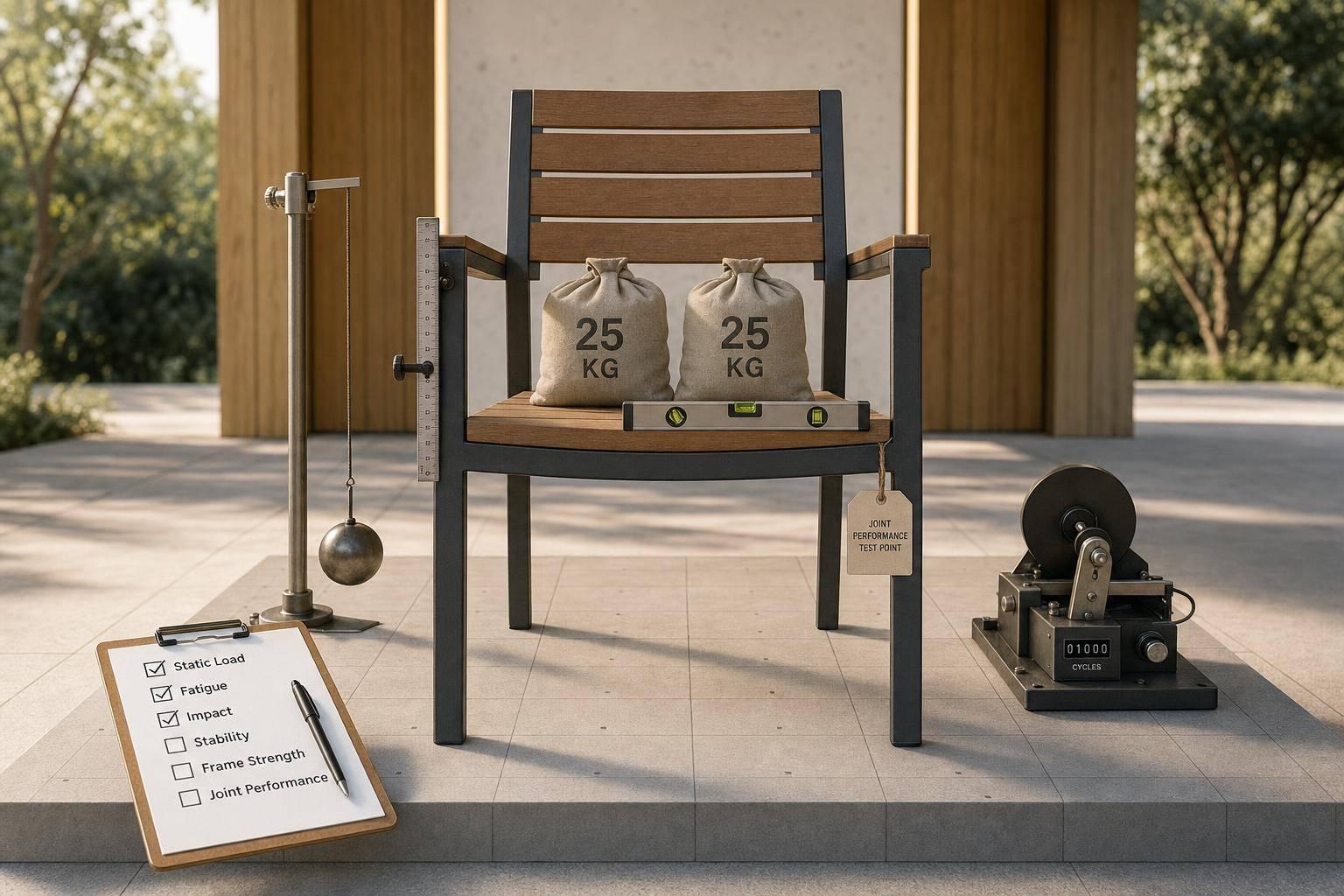
If I had to check only a few files before approving outdoor seating, I’d start with six: static load, fatigue, impact, stability, frame strength, and joint records. Those files show whether a chair, lounger, or bench can take weight, repeat use, sudden hits, and tip risk - and whether the tested sample matches the SKU I plan to buy.
In plain terms, this record list helps me answer three questions fast:
- Can the product take the load?
- Can it last through repeat use and moving parts?
- Do the records match the item being shipped?
I’d also look for a few hard numbers right away. For example, the article points to 10.000 opening/closing cycles for folding mechanisms, a 25 kg seat impactor dropped from 180 mm for 10 cycles, and static checks such as 1.600 N on the seat, 410 N on the backrest, and 600 N on the armrest. If those figures, test dates, sample IDs, and photos are missing, the file set is weak.
What matters most depends on the seating type:
- Chairs: load, fatigue, and tip resistance
- Loungers: recline position, backrest interface, and moving-part wear
- Benches: multi-user load, span strength, and joint movement
- Folding chairs: locking parts, hinges, and frame play after cycling
Outdoor Seating Test Standards: Priority Records by Seating Type
| Seating type | Files I’d check first | Main risk |
|---|---|---|
| Chair | Static load, fatigue, stability | Tipping, loosening, frame set |
| Lounger | Stability, joint, mechanism cycle record | Rear tip, recline failure, pinch risk |
| Bench | Multi-person load, frame, joint record | Mid-span bend, uneven loading |
| Folding chair | Locking, hinge, fatigue, stability | Collapse, play in joints, poor lock hold |
So, my short take is simple: a pass/fail line is not enough. I want the test standard, forces, cycle count, post-test condition, sample ID, lab name, date, and photos in each file before I move to sample approval or order release.
Static load records show how a chair handles a single heavy load. Fatigue records show how it holds up when that load happens again and again.
Static load records: seat, back, front edge, and legs
Each static load record focuses on one part of the chair. A full set covers the seat surface, the backrest, the front edge of the seat, and the legs. Each one is tested on its own, with its own force, load point, and hold time.
| Record Type | Key Data Points | What to Check |
|---|---|---|
| Seat static load | Applied force (N), load point, hold time | Pass/fail result; cracking or permanent set notes |
| Back static load | Applied force (N), load point, hold time | Pass/fail result; cracking or permanent set notes |
| Seat front edge load | Applied force (N), hold time | Permanent set observations; no cracking at the edge |
| Leg load | Applied force (N), force direction, hold time | Joint integrity; no loosening at connection points |
| Armrest load, where applicable | Vertical and horizontal force (N), load point | Pass/fail result; cracking or breakage notes |
Don’t stop at a simple pass/fail line. That only tells part of the story. The record should also note the post-load condition, including permanent set, cracking, or breakage.
After these one-time strength checks, buyers usually move to fatigue records to see how the chair performs under repeated use.
Fatigue records: repeated loading on seat and back
Fatigue records are about repetition. A chair can pass a static load test and still start to loosen, shift, or deform after many cycles. That’s the difference between surviving one hard push and living through daily use.
Record the post-test condition in plain terms: loosening, deformation, or damage in the frame, fabric, fasteners, or joints. Alongside that, include the cycle count, force level, speed, and post-test condition next to the tested build details.
Next, review impact and stability records, which cover sudden loading and tip-over risk.
Impact records for sudden loading
After repeated-load files, review the impact records for sudden shocks and concentrated force.
An impact record tells you if the product can take a sudden hit without cracking, tearing, loosening, or losing function. The fields that matter most are drop mass, drop height, number of impacts, impact location, pass/fail criteria, and any visible or functional damage after testing.
For outdoor seating tested under EN 1728, the standard seat impact test uses a 25 kg impactor dropped from 180 mm, repeated for 10 cycles onto the seat pan. After the test, the product should show no functional damage, cracking, or unsafe deformation.
EN 581‑2 also includes a backrest impact check for products with backrests, using a pendulum or impact hammer that strikes the top of the backrest.
The tested area should line up with the product’s most likely weak point. If a report only covers the seat centre, it can miss trouble at the backrest connection or a folding joint. For loungers, the file should also cover the adjustable backrest interface. For benches, pay close attention to the seat span and any unsupported centre section.
Stability records: forward, rearward, sideways, and corner
Stability records show whether a product tips under set loading conditions. Under EN 581‑2 and EN 1022, tests apply force at the seat, arms, back, or footrest in four directions - forward, rearward, sideways, and corner. Any tip-over means the product fails.
These records matter most for a few product types:
- Loungers with adjustable backrests can become rear-heavy at some recline angles.
- Folding chairs and lightweight frames need close review because small geometry changes can lead to instability.
- Benches with a narrow footprint or unusual leg geometry are more exposed to sideways and uneven loading, like when one person sits at one end.
Check that the tested setup reflects the most unstable real-use position, not only the standard seated posture.
If the product passes stability, look one step further. Make sure the frame and joints keep the same shape under load.
Frame strength and joint performance records
Frame strength records should state which parts were tested - seat frame, back frame, arms, legs, stretcher bars, and support rails - and confirm that the tested sample matches the production design in material thickness, tube diameter, and reinforcement. EN 581‑2 sets numeric thresholds for outdoor seating records: a 1 600 N static seat load, a 410 N horizontal backrest load, a 600 N armrest load, and 10 000 opening/closing cycles for folding mechanisms.
Joint records often show where risk is hiding. They should state whether any part loosened, cracked, separated, bent, or changed geometry after loading. Even if the report says pass, any post-test joint movement or play should be treated as a sourcing risk.
Next, confirm that each file includes the required fields and matches the production sample.
Minimum fields every test record should include
After load, impact, and stability checks, audit each file for traceability and sample match.
A test record only helps if it gives you enough detail to confirm that the tested sample is the same product you plan to buy. Each file should clearly show the standard reference (for example, EN 581-2), a product description, a sample ID, the product type, the test date, and the laboratory name. It should also include the exact test parameters, a pass/fail result, and any post-test deformation or damage found after testing.
Photos of the tested sample matter too. They help with sample confirmation and make traceability easier. If photos are missing, treat the file as incomplete until the supplier sends them.
Which records matter most by seating type
Once the file is complete, sort the records based on the seating type you are buying.
Not every record matters in the same way for every product. A chair, for example, lives or dies on stability and load data. A lounger needs close review of its moving parts. A bench has to show that the frame can handle more than one person at the same time without bending out of shape.
The table below shows which records deserve the closest look for each main seating category.
| Seating Type | Priority Test Records | Purpose of Check | File Check |
|---|---|---|---|
| Chairs | Stability, Static Load | Prevent tipping; verify weight capacity for single users | Confirm pass/fail result and post-test joint condition |
| Loungers | Folding Action, Joint Performance | Ensure mechanism safety; check for pinch points in reclining parts | Confirm folding-mechanism record matches the tested SKU |
| Benches | Multi-person Static Load, Frame Strength | Confirm the frame supports simultaneous users without deformation | Confirm force levels and span dimensions match the production design |
Keep the review focused on the test file itself, not shipping or carton checks.
Once the file set is complete, the final review is pretty simple. For outdoor seating, the core records are static load, fatigue, impact, stability, frame strength, and joint performance.
Clear records help lower approval risk because each test file is tied to the exact sample, SKU, and order.
Incomplete files don’t prove product readiness.
How do I verify the tested sample matches my SKU?
Confirm the product’s technical specifications in writing before you place the order. That gives you a clear reference point and helps avoid mix-ups later.
During production, use a pre-shipment inspection to check that the product details, packaging, and loading match the agreed requirements. It’s a simple step, but it can save a lot of back-and-forth.
You can also ask for and review official test reports. If needed, NINGBO YUFEI staff can help explain the documents, and you may appoint an independent certification authority for extra verification.
Which test records matter most for folding chairs and loungers?
For folding chairs and loungers, the most important test records focus on safety and durability in day-to-day use.
They usually cover:
- static load
- fatigue
- impact
- stability
- frame strength
- joint performance
These records help confirm weight capacity, resistance to repeated use and sudden force, and structural integrity during frequent folding and unfolding.
What makes a seating test file incomplete?
A seating test file is incomplete if it leaves out the records needed for quality checks and compliance.
For outdoor seating, that usually means records for static load, fatigue, impact, stability, frame strength, and joint performance. It also includes product specs, packaging details, and verified inspection results used for pre-shipment validation.